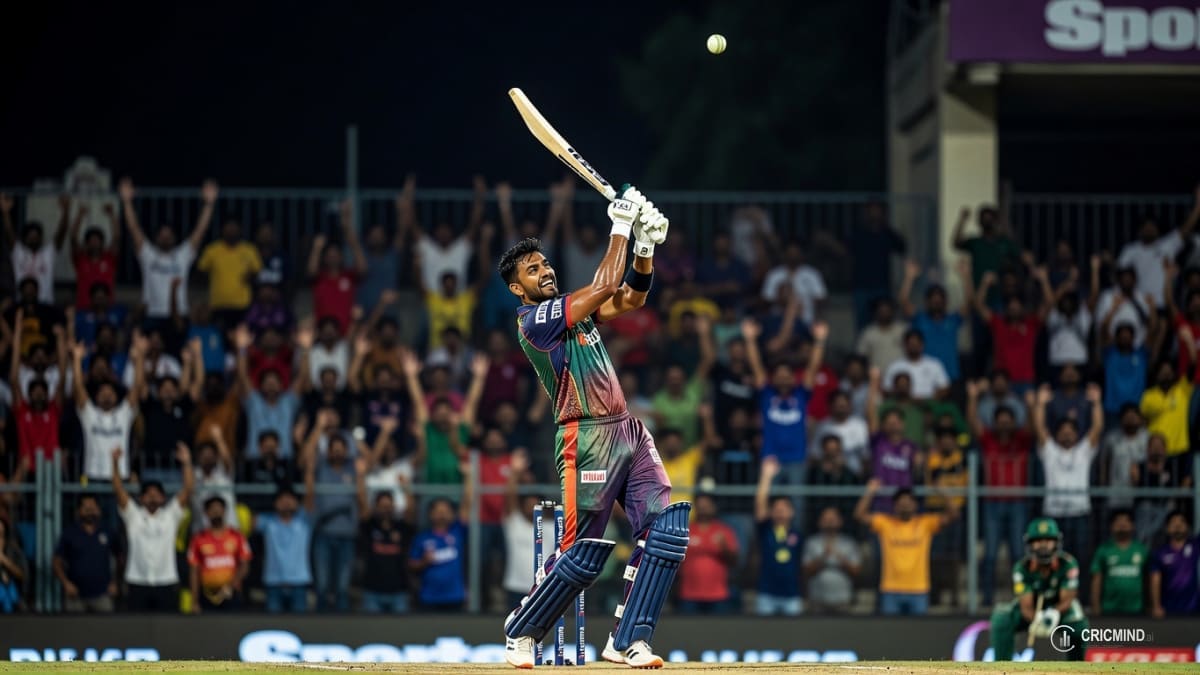
The Two-Minute Pause That Changes Everything
There is a moment in almost every IPL match — somewhere around the seventh or eighth over of a powerhouse batting innings — when a captain walks to the boundary rope, gathers his bowlers and fielders, and the television director cuts to an advertisement break. The crowd hums. The batting team huddles at the other end. And somewhere in that brief suspension of play, the game can genuinely shift.
The strategic timeout. Two minutes. Two per innings. A mechanism borrowed from basketball and American football, grafted onto the oldest bat-and-ball game on earth. Seventeen seasons of IPL cricket across 1,169 matches have given us enough evidence to ask the question seriously: do they actually work?
The answer, as with most things in cricket, is complicated, contextual, and absolutely worth arguing about.
What the Timeout Is Supposed to Do
The formal structure is simple. Each team gets two timeouts per innings — one mandatory window between overs six and ten, and another between overs thirteen and seventeen. The fielding captain calls it when the bowling side needs it; the batting side can call it when they need to regroup. In theory, it is a reset button. In practice, it is a chess clock pause during a game of speed chess.
The bowling team uses it to disrupt rhythm. If Virat Kohli is in one of those periods where he has found his timing and the boundary rope keeps getting visited, the last thing you want is continuity. Break his rhythm. Change the field. Shift the bowler. Introduce doubt. This is the tactical logic, and it is sound.
The batting team, conversely, uses it to take stock of the equation. How many overs remain? Which bowlers haven't finished their quota? Where are the fielders positioned for the next three overs? It is a planning pause as much as a breathing one.
But here is where it gets genuinely interesting: whether the interruption helps the team that calls it, or the team that didn't ask for one, is far from settled science.
Reading the Data Through Great Performances
The provided match data does not break down run rates pre- and post-timeout at a granular level, but what it does give us is a portrait of the players and phases where timeouts are most consequential — and that portrait is illuminating.
Consider the top-order batsmen who dominate IPL run charts. Virat Kohli has scored 8,671 runs across 261 innings at a strike rate of 132.93. David Warner averages 40.04 with a strike rate of 139.66. These are batsmen who build through Phases One and Two — precisely the timeout windows. A timeout called at over seven, when either of these men has crossed 30 off 25 balls, is not a gamble. It is an operational necessity.
Then there is the other category: the players who make timeouts almost irrelevant. Chris Gayle hit 359 sixes in IPL history — the most of any player — and his 175 not out against Pune Warriors remains the tournament's highest individual score, arriving at a strike rate of 265.15. No two-minute conversation in the world consistently stops a batsman operating at nearly three runs per ball. AB de Villiers at his peak — 151.89 career strike rate, three IPL centuries — was similarly impervious to tactical resets once he entered that particular mode.
The timeout, in those cases, becomes more psychological than tactical. You are not disrupting a mechanism; you are hoping to interrupt a mood.
The Bowling Perspective: Where Timeouts Show Their Real Value
From the bowling end, the timeout's effectiveness becomes easier to trace — even qualitatively, even without ball-by-ball run-rate data.
Look at the IPL's elite bowlers through this lens. Jasprit Bumrah has 186 wickets from 145 matches at an economy of just 7.12, the best among high-volume pacers in the dataset. Lasith Malinga averaged 19.46 with 170 wickets. Sunil Narine maintains a 6.79 economy across 187 matches — the lowest of any frontline bowler with comparable workload.
| Bowler | Wickets | Economy | Average |
|---|---|---|---|
| JJ Bumrah | 186 | 7.12 | 21.65 |
| SL Malinga | 170 | 6.98 | 19.46 |
| SP Narine | 192 | 6.79 | 25.70 |
| Rashid Khan | 158 | 7.14 | 24.13 |
| A Mishra | 174 | 7.28 | 23.64 |
These bowlers perform consistently enough that a timeout can be used to set them up rather than rescue a situation. A captain with Bumrah in hand at over fourteen, with six runs needed to defend per ball, can use the timeout to place fields with surgical precision and allow Bumrah to operate on a completely clean, agreed tactical canvas. That is the timeout at its most potent: not panic, but precision.
Contrast that with a scenario where 8.16 economy rate bowlers — think Dwayne Bravo's category, where you need swing and variation, not raw pace — are leaking runs between overs twelve and sixteen. The timeout here is reactive rather than proactive. You are trying to plug a hole. Whether the timeout stops the leak depends almost entirely on the quality of bowling and fielding in the overs that follow.
When the Batting Team Calls It: The Pressure Reset
The batting team's timeout has a different emotional texture. It tends to be called when wickets have fallen in a cluster, when the required rate has climbed above fourteen, or when a particular bowler — a Rashid Khan or a Narine, someone who spins riddles rather than bowls deliveries — has turned the middle overs into a maze.
MS Dhoni was perhaps the greatest practitioner of the batting-side timeout. His career numbers — 5,439 runs, 99 not outs, a strike rate of 137.45 — were built around his extraordinary ability to recalibrate a chase from any position. A Dhoni-era Chennai Super Kings timeout in a chase was never just about rest. It was a forensic deconstruction of what the bowling side was trying to do, and a precise prescription for dismantling it ball by ball. Chennai won five IPL titles in significant part because of this capacity to process information and act calmly under pressure.
The team with the fewest titles — Royal Challengers Bangalore until their 2025 triumph — often appeared to call timeouts in moments of crisis without the decisiveness to implement the plan. Talent was never the issue; execution under pressure frequently was. The timeout reveals what a team is made of when the crowd falls quiet and the plan has to be spoken plainly.
The Momentum Question
Here is the deepest question the timeout raises, and the one that data from any single match never fully resolves: is momentum real in T20 cricket, and if so, can two minutes interrupt it?
Across the 1,169 IPL matches in this dataset, venues like Wankhede Stadium (average first-innings score: 166) and M Chinnaswamy Stadium (average first-innings score: 168) consistently produce high-scoring games where the batting side accumulates quickly enough that the timeout window must be used aggressively. At Eden Gardens, where chasing teams win 61 percent of matches, the fielding side needs every weapon available — the timeout included.
These numbers suggest that venue context changes how a timeout should be deployed. At a high-scoring venue, calling the timeout to disrupt a set batsman in over eight is urgent and necessary. At a slower, lower-scoring venue, the timeout might be better saved for the death overs — the sixteen-to-eighteen window where a bowling change, a field adjustment, and a quiet two minutes can be the difference between defending a target and watching it crumble.