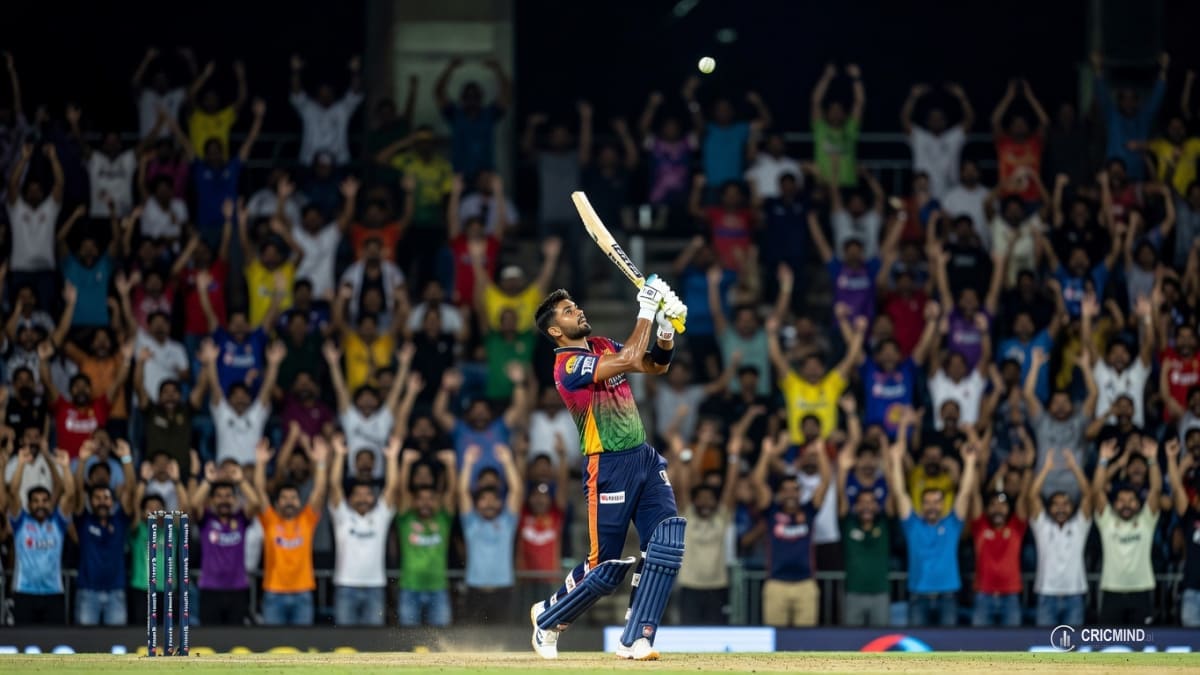
When the Algorithm Watches Cricket
There is a moment in every close IPL match — the kind where eight runs are needed off the last over with two wickets in hand — when every fan in the stadium believes they know what happens next. They have watched the game long enough. They have a feel for it. What machine learning asks, quietly and without ego, is a simple question: what if we replaced that feel with seventeen years of evidence?
CricMind.ai's prediction engine is built on exactly that premise. Trained on 1,169 IPL matches spanning 2008 to 2025, it does not watch cricket the way a fan does. It reads it — as a structured river of decisions, outcomes, and probabilities, each data point a thread in a tapestry that most human minds cannot hold together simultaneously. Understanding how that engine works means understanding both the beauty of the sport and the discipline of the science.
The Raw Material: What the Model Actually Sees
Before a single prediction is generated, the data has to be clean, complete, and contextualised. Across 17 seasons of IPL cricket, the dataset contains performance records for batters, bowlers, venues, and teams — all in their full, granular detail.
Consider what the model inherits when it processes batting data. Virat Kohli across 261 innings at an average of 39.59 and a strike rate of 132.93 is not just a number — it is a distribution. The model learns that Kohli has scored 63 fifties and 8 hundreds, that he converts starts at a certain rate, and that his baseline is consistent enough to anchor any probability model built around Royal Challengers Bengaluru innings.
Contrast that with AB de Villiers, whose career strike rate of 151.89 across 172 innings tells a different story — one of explosive acceleration rather than steady accumulation. Or MS Dhoni, who converted 99 of his 241 innings into not-outs with a strike rate of 137.45, a statistical signature that screams finisher before the algorithm has processed a single delivery.
These are not anecdotes. They are features — the vocabulary the machine uses to speak about players.
Feature Engineering: Turning Cricket into Mathematics
Raw statistics do not enter a model as you see them in a scorecard. They are transformed. A player's average becomes a rolling average weighted by recent form. A venue's character becomes a numerical bias applied to every innings projected to be played there.
The venue data in our dataset reveals patterns that any experienced observer would recognise but struggle to quantify precisely:
| Venue | Matches | Avg 1st Innings | Avg 2nd Innings | Field First Win % |
|---|---|---|---|---|
| M Chinnaswamy Stadium | 65 | 168 | 146 | 55% |
| Wankhede Stadium | 73 | 166 | 154 | 51% |
| Eden Gardens | 77 | 160 | 147 | 61% |
| Feroz Shah Kotla | 60 | 162 | 148 | 53% |
Look at what these numbers do for a prediction model. Eden Gardens, across 77 matches, shows teams fielding first winning 61% of the time — a statistically significant lean that no model should ignore when Kolkata Knight Riders win the toss at home. M Chinnaswamy Stadium carries an average first-innings score of 168, the highest in this dataset, which immediately adjusts the baseline projection for any RCB home game upward.
The algorithm absorbs all of this. A toss decision at Eden Gardens shifts the win probability for the fielding team not because a developer hardcoded a rule, but because the model learned that relationship from 77 matches of evidence.
Model Architecture: What Kind of Machine Learning?
Cricket prediction at this level typically involves an ensemble approach — multiple model types working in concert, each contributing where it is strongest.
Gradient boosted trees handle structured tabular data with precision. They are particularly effective at capturing the non-linear relationships that define cricket: a bowler with an economy of 6.79, like Sunil Narine of Kolkata Knight Riders, does not simply make scoring marginally harder — in certain match contexts, against certain batting lineups, his presence in a lineup restructures the entire game plan of the opposition. Tree-based models capture these interaction effects naturally.
Recurrent neural networks or transformer-based sequence models handle the temporal dimension — the within-match progression of probability that changes ball by ball. When Jasprit Bumrah has an economy of 7.12 from 149 innings with 186 wickets at an average of 21.65, and he enters to bowl the 19th over of a chase, the model updates its win probability not just on his aggregate numbers but on the specific game state, the batters at the crease, and the historical outcomes of comparable moments.
Logistic regression, simpler but interpretable, often serves as a calibration layer — ensuring that the model's confidence scores translate meaningfully into actual probabilities rather than overconfident outputs.
The Signal in the Sixes
One of the more elegant features in the CricMind.ai model is what might be called the aggressive intent index — a measure derived from boundary-hitting data that captures how a batter reshapes a game when they are in full flow.
The all-time six-hitting leaderboard from our dataset makes this vivid:
| Player | Sixes | Innings | Team(s) |
|---|---|---|---|
| CH Gayle | 359 | 145 | RCB, PBKS, KKR |
| RG Sharma | 303 | 267 | MI, SRH |
| V Kohli | 292 | 261 | RCB |
| MS Dhoni | 264 | 241 | CSK, RPS |
| AB de Villiers | 253 | 172 | RCB, DC |
Chris Gayle's 359 sixes from 145 innings is not just a record — it is a probability distribution that shifts dramatically when he is at the crease. His highest score of 175\ off 66 balls, struck at a strike rate of 265.15* against Pune Warriors in 2013, represents an outlier event that the model must both account for and not over-weight. This is the calibration problem at the heart of T20 machine learning: how do you model genius without teaching the machine to expect it every time?
The answer lies in variance modelling. Gayle's career is characterised by a wide spread of outcomes — the model does not predict 175 every time he bats, but it does widen the confidence interval around his innings projection and raises the ceiling of what the batting team can score.
Learning from Champions
Seventeen seasons of IPL champions form a rich training set for understanding what winning actually looks like structurally. Mumbai Indians have won 5 titles from 277 matches at a win percentage of 54.5%. Chennai Super Kings have also claimed 5 titles from 252 matches at a win percentage of 56.3% — the highest among the established franchises in this dataset.
The model learns not just that these teams win, but why. Chennai's win percentage of 56.3% combined with Dhoni's finishing role — a player who was not out in 99 of 241 innings and struck at 137.45 — suggests a team structurally designed to minimise variance in the final overs. That is a learnable pattern.
At the other end, the newer franchises provide a different kind of signal. Gujarat Titans achieved a win percentage of 61.7% across their 60 matches, winning the title in their debut season in 2022. That outlier efficiency, compressed into a smaller sample, teaches the model how quickly team quality can be established — and how dangerous it is to anchor predictions to historical reputation alone.