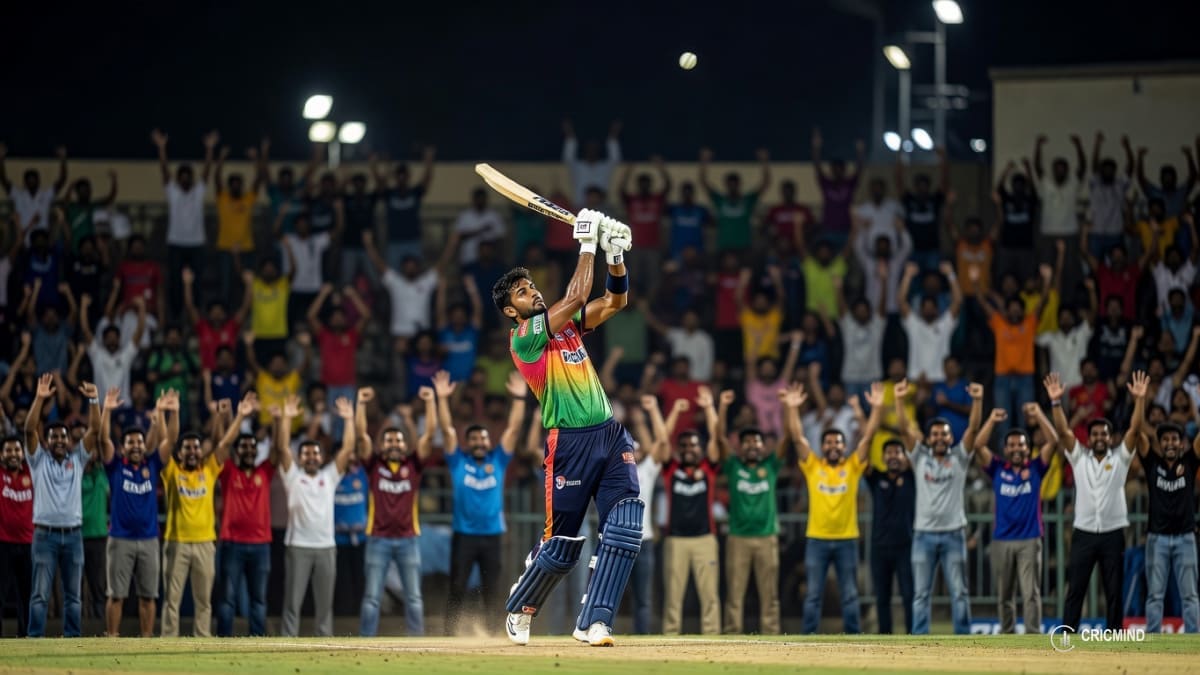
The Six Overs That Shape Everything
There is a moment, somewhere around the third ball of an IPL powerplay, when a match quietly decides what it wants to become. The field is up, the new ball is hard, and two batsmen at the crease are either building something or conceding it. By the time those six overs are done, roughly a third of a T20 innings has been played — and with it, the psychological contract between two teams has been written in either ink or pencil.
Across 1,169 IPL matches spanning 2008 to 2025, the evidence is overwhelming: what happens at the top of the order does not merely influence games. It defines them. The opening partnership is the load-bearing wall of a T20 innings — knock it out, and everything above it comes down.
What the Data Actually Tells Us
The numbers that live quietly inside match results tell a story that tactics boards have known for years. When openers fire in tandem — building a platform that shifts run-rate pressure onto the bowling side — the chasing or setting equation tilts dramatically. Venues like the M Chinnaswamy Stadium average 168 runs in the first innings, and the highest total ever recorded there reached 263. That kind of score does not emerge from middle-order heroics alone. It is scaffolded from the first over.
Consider the most dominant opening innings in IPL history. Chris Gayle — playing for Royal Challengers Bangalore against Pune Warriors at Chinnaswamy in 2013 — struck 175 not out off 66 balls at a strike rate of 265.15, hitting 17 sixes and 13 fours. That was not just a batting performance. It was a declaration. By the time Gayle was done, the match was over as a contest. He had walked to the crease as an opener and turned six overs into a statement that lasted twenty.
The very first IPL match told the same story. Brendon McCullum's 158 not out off 73 balls for Kolkata Knight Riders against RCB in 2007, featuring 13 sixes and a strike rate of 216.44, set the template for what an opening blitz could do — not just to a scoreboard, but to a sport.
The Architects: Who Built Those Foundations
To understand why opening partnerships matter, study the men who played them longest and best.
| Batsman | Matches | Runs | Average | Strike Rate | Fifties | Hundreds |
|---|---|---|---|---|---|---|
| V Kohli | 259 | 8,671 | 39.59 | 132.93 | 63 | 8 |
| DA Warner | 184 | 6,567 | 40.04 | 139.66 | 62 | 4 |
| S Dhawan | 221 | 6,769 | 35.07 | 127.09 | 51 | 2 |
| RG Sharma | 266 | 7,048 | 29.86 | 132.06 | 47 | 2 |
| KL Rahul | 135 | 5,235 | 45.92 | 136.04 | 40 | 5 |
These are not just the game's leading scorers. They are the game's most reliable frame-builders. KL Rahul averaged 40.04 across 184 matches with a strike rate of 139.66 — a pairing of volume and velocity that is extraordinarily rare. KL Rahul's average of 45.92 is the best in this group, and his 132 not out off 69 balls for Punjab Kings against RCB in 2020 stands as one of the finest solo opening contributions the tournament has seen.
Virat Kohli's 8,671 runs across 259 matches represent the all-time IPL scoring record — but the texture of those runs matters as much as the volume. His 63 half-centuries dwarf everyone else in this list, suggesting a batter who consistently got his team to 50-60 in the powerplay and rarely surrendered his wicket cheaply in the period when it is most costly.
Yashasvi Jaiswal brought something different — an almost metronomic quality across 221 matches for four different franchises, accumulating 6,769 runs with 768 fours — more than anyone else in this analysis bar Kohli. Dhawan's boundaries were predominantly along the ground, which means he was rotating strike, finding gaps, and constructing partnerships ball by ball rather than over by over.
Why the Powerplay Creates Irreversible Momentum
The structural logic is simple but ruthless. In T20 cricket, overs 1-6 are the only period where fielding restrictions force the bowling side to defend the entire ground with limited catchers on the boundary. A batting team that capitalises fully — posting, say, 60-plus without losing a wicket — arrives at overs 7-14 with their best batsmen still at the crease and a run rate that puts opponents under immediate pressure.
Conversely, a team that loses both openers inside the powerplay often finds itself in a different match entirely. Middle-order batsmen — however gifted — inherit a deficit of balls that can never be recovered cleanly. They bat under psychological debt.
Look at what the venue data reveals. At Wankhede Stadium, the average first innings score sits at 166, with teams fielding first winning 51% of matches — almost perfectly balanced. At Eden Gardens, that balance shifts: teams fielding first win 61% of the time, even though the average first innings score is 160. The difference is not always pace or spin. Often, it is whether the chasing team's openers arrived at the crease free or under siege.
The Champions and Their Openers
Run your eye across the IPL honour roll and the pattern holds. Mumbai Indians, with five titles, built their dominance across an era in which Rohit Sharma was not just a captain but the team's most consistent source of top-of-innings stability. His 303 sixes — second only to Gayle all-time — were not struck by a man who batted at five. They came, overwhelmingly, from an opener who knew when to accelerate and when to bat the field into submission.
Chennai Super Kings won their five titles through a different architectural philosophy — one that trusted the powerplay to do controlled damage rather than maximum carnage. Their run-rate targets were often achieved through precision rather than power, which is why a batter like Faf du Plessis — 4,773 runs at a strike rate of 135.79 with 39 fifties — became such a trusted commodity at the top of multiple franchise orders.
Kolkata Knight Riders won three titles, with their 2024 triumph powered by an era in which Sunil Narine's transformation into a destructive opener fundamentally changed how T20 cricket thought about powerplay exploitation. Narine's 192 wickets are well-documented, but it is his late-career reinvention as a batting weapon at the top of the order that represents perhaps the most tactically disruptive development in modern IPL history.
The Gayle Effect: What a Dominant Opening Innings Does to a Tournament
It is worth pausing on Chris Gayle's numbers because they represent the outer limit of what opening batting can mean. Across 141 matches, he struck 359 sixes — the most in IPL history by a distance — with a strike rate of 149.34 and an average of 39.66. He scored 6 centuries and 31 fifties.
What those numbers cannot capture is the