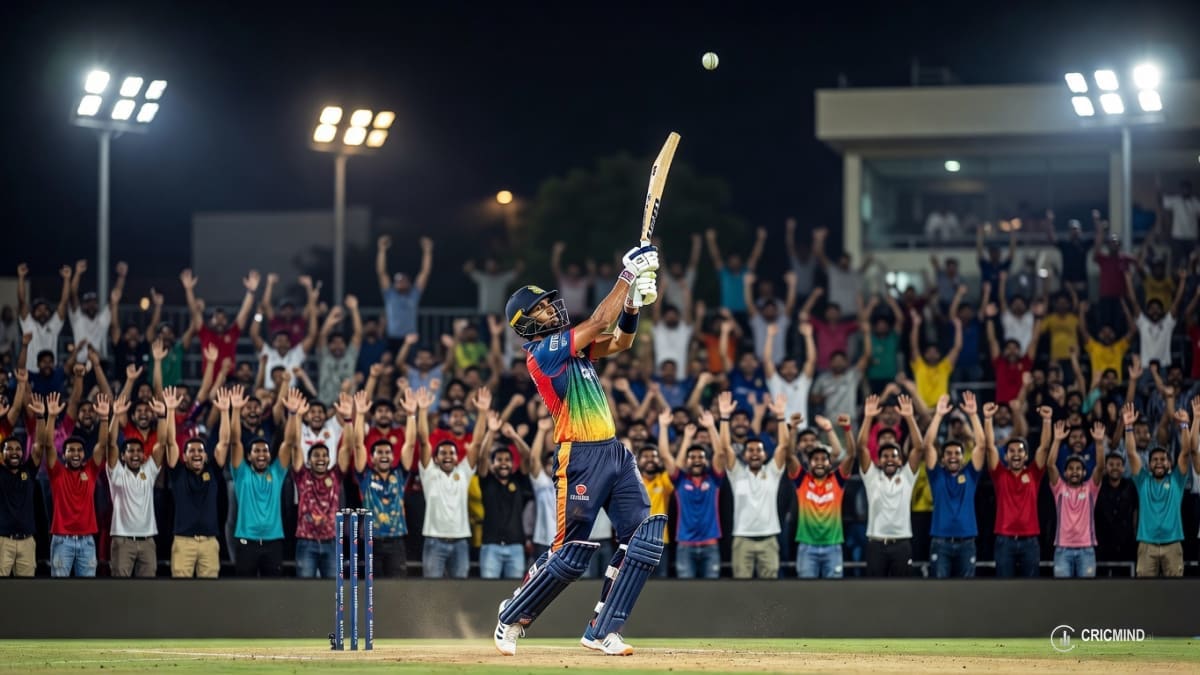
The Last Frontier: Why Fielding Analytics Is Cricket's Most Undervalued Intelligence
There is a moment in every close IPL match — a diving stop at deep midwicket, a relay throw that runs out a set batter, a catch at long-on that transforms a franchise's evening — where the outcome of the game pivots not on a boundary or a wicket, but on a fielder's instinct and athleticism. For seventeen seasons, we have obsessively catalogued batting averages and bowling economies. We have built entire narratives around Virat Kohli's 8,671 runs and Jasprit Bumrah's 21.65 bowling average. Yet the discipline that quietly determines six to eight runs per match — fielding — has existed largely in the analytical shadows.
That is changing. Runs Saved Above Average, the cricket adaptation of defensive metrics borrowed from baseball sabermetrics, is becoming the lens through which the smartest IPL franchises now evaluate roster construction. This piece examines what the concept means, why it matters, and what the 1,169 matches of IPL data from 2008 through 2025 tell us about the hidden economy of fielding.
What Is Runs Saved Above Average?
Runs Saved Above Average, often abbreviated as RSAA, is a metric that attempts to quantify how many runs a fielder saves compared to what a positional average would concede in the same scenario. It accounts for boundary prevention at the rope, ground fielding efficiency in the outfield and infield, direct-hit attempts, catches taken versus drops, and positional discipline in restricting twos from becoming threes.
The key word is above average. A fielder who saves exactly what the average player would save registers zero. Every run prevented beyond expectation is positive value; every misfield, dropped catch, or boundary conceded on a fifty-fifty is negative. Over a full IPL season of fourteen to seventeen matches, elite fielders accumulate a RSAA that directly translates to winning margins.
In T20 cricket, where individual games are decided by three or four runs with remarkable frequency, a single fielder with a consistently positive RSAA is not a luxury — he is a match-winner wearing a batting jersey.
The Fielding Dimension Hidden Inside Batting Numbers
Here is something the batting leaderboard conceals: several of the IPL's most celebrated batters have been elite athletes in the field who doubled their value to the franchise. Consider the careers that sit alongside the run tallies.
Ravindra Jadeja (RR) — who has taken 170 wickets across 225 matches for Chennai Super Kings and other franchises — has been, by almost any observational measure, the finest all-round fielder the IPL has produced. His run-outs and boundary saves at backward point and midwicket have been a constant feature of CSK's title campaigns across five championship seasons. His value in the RSAA framework would extend dramatically beyond what the bowling average of 30.29 or the wicket tally alone communicates.
Similarly, AB de Villiers, who accumulated 5,181 runs at a strike rate of 151.89 for Royal Challengers Bangalore, was widely regarded as one of the most technically accomplished fielders of his generation — a player whose value at cover or in the deep was not captured by any box score.
The point is not rhetorical. When franchises bid tens of crores in the auction, they are bidding on a number that captures only batting or bowling contribution. The fielding dimension — worth, conservatively, a run per match for an elite performer over an average one — disappears entirely from the valuation model.
Venue Context: Why Fielding Difficulty Varies
Not all grounds impose equal fielding demands, and an RSAA system must be venue-adjusted to be meaningful. The data from IPL's major venues reveals stark differences in scoring environment that directly affect fielding pressure.
| Venue | Matches | Avg 1st Innings | Avg 2nd Innings | Field First Win % |
|---|---|---|---|---|
| M Chinnaswamy Stadium | 65 | 168 | 146 | 55% |
| Wankhede Stadium | 73 | 166 | 154 | 51% |
| Eden Gardens | 77 | 160 | 147 | 61% |
| Feroz Shah Kotla | 60 | 162 | 148 | 53% |
| Wankhede (DY Patil data) | 52 | 177 | 168 | 60% |
M Chinnaswamy Stadium in Bangalore, with a first-innings average of 168 and the highest total in IPL history at 263, imposes the most severe fielding demands in the tournament. The short boundaries and fast outfield mean every misfield is expensive; an average fielder concedes significantly more here than at Eden Gardens, where the larger ground and denser outfield grass create a more forgiving environment.
A runs-saved model that ignores these venue adjustments will systematically undervalue fielders who play half their matches at Chinnaswamy and overvalue those who operate at Eden Gardens. IPL teams that have dominated — Chennai Super Kings with 56.3% win rate across 252 matches, Mumbai Indians with 54.5% across 277 — have been precisely the franchises that optimise these contextual factors in team selection.
The Bowling-Fielding Interface: Economy Rates as a Proxy
While direct RSAA data is not yet publicly distributed at scale, bowling economy rates offer a compelling proxy for understanding how fielding quality affects run prevention. A bowler does not exist in isolation — he is supported or undermined by the eleven bodies around him.
| Bowler | Matches | Wickets | Economy | Average |
|---|---|---|---|---|
| SP Narine | 187 | 192 | 6.79 | 25.70 |
| SL Malinga | 122 | 170 | 6.98 | 19.46 |
| JJ Bumrah | 145 | 186 | 7.12 | 21.65 |
| Rashid Khan | 136 | 158 | 7.14 | 24.13 |
| R Ashwin | 217 | 187 | 7.03 | 29.56 |
Sunil Narine's economy of 6.79 across 187 matches for Kolkata Knight Riders is the most miserly of any high-volume IPL bowler in the dataset. But Narine bowled for a franchise that has historically prided itself on athletic fielding units. Isolating how much of that economy is Narine's craft versus excellent ground fielding behind his deliveries is precisely the question RSAA frameworks are designed to answer.
Lasith Malinga's 6.98 economy across 122 matches tells a similar story for Mumbai Indians — a franchise with five titles built on the premise that fielding excellence is non-negotiable. When Malinga was firing yorkers at the death, the boundary riders behind him were not decoration.
The Catch Rate Conundrum: Where RSAA Gets Complicated
The most analytically contentious element of runs saved models in T20 cricket is the treatment of catches. A dropped catch in the power play off a batter who goes on to score sixty is obviously catastrophic. But how do you weight it against a boundary save that prevents a six? Both affect the scoreline; only one appears in the scorebook.