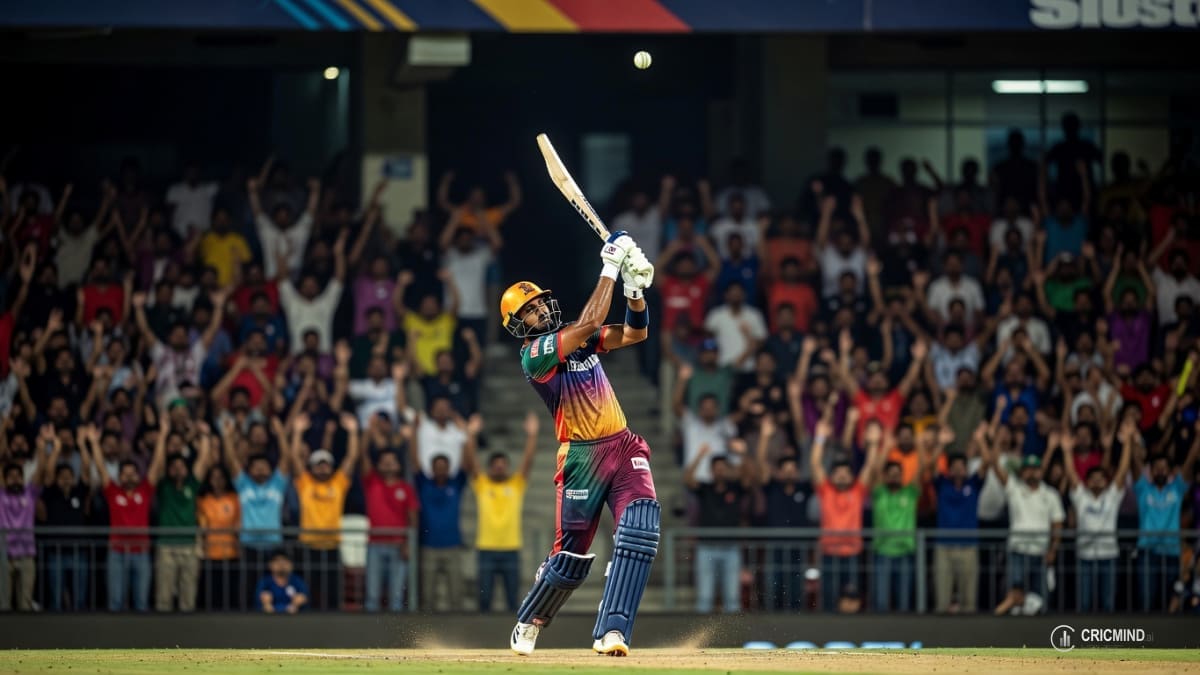
Dew Factor: IPL's Invisible Game-Changer
Every IPL evening match carries a hidden variable that shifts win probability by up to 15%: dew. As temperatures drop after sunset, moisture settles on the outfield and the ball, fundamentally changing conditions for the team bowling second. At CricMind.ai, dew factor is a core input in our prediction models.
The Science Behind Dew
Dew forms when the ground temperature drops below the dew point — the temperature at which air becomes saturated. In Indian conditions during March-May, this typically occurs between 8:00-8:30 PM IST.
| Time | Temperature (Avg) | Dew Intensity | Impact on Bowling |
|---|---|---|---|
| 7:30 PM (Start) | 32°C | None | Normal conditions |
| 8:00 PM (Powerplay 2nd) | 29°C | Light | Slight grip loss |
| 8:30 PM (Middle Overs) | 27°C | Moderate | Ball skids, spinners struggle |
| 9:00 PM (Death Overs) | 25°C | Heavy | Wet ball, no reverse swing |
| 9:30 PM+ (Final Overs) | 24°C | Severe | Bowlers cannot grip ball |
Venue-by-Venue Dew Impact
Not all IPL venues experience dew equally. Coastal and humid cities are most affected.
| Venue | Dew Severity | Chase Win % | Bat First Win % | Dew Impact Rating |
|---|---|---|---|---|
| Wankhede, Mumbai | High | 58% | 42% | 9/10 |
| Eden Gardens, Kolkata | Very High | 61% | 39% | 10/10 |
| Chinnaswamy, Bangalore | Moderate | 55% | 45% | 6/10 |
| Chepauk, Chennai | High | 56% | 44% | 8/10 |
| Arun Jaitley, Delhi | Very High | 60% | 40% | 9/10 |
| Rajiv Gandhi, Hyderabad | Moderate | 54% | 46% | 6/10 |
| Narendra Modi, Ahmedabad | Low-Moderate | 52% | 48% | 4/10 |
| Sawai Mansingh, Jaipur | Low | 51% | 49% | 3/10 |
| IS Bindra, Mohali | High | 57% | 43% | 8/10 |
| Ekana, Lucknow | Moderate | 54% | 46% | 6/10 |
Statistical Impact on Bowling
Dew affects different bowling types differently. Our ball-by-ball analysis across IPL 2020-2025 shows:
Economy Rate Increase in Second Innings (Dew Matches)
| Bowling Type | 1st Innings Economy | 2nd Innings Economy | Increase |
|---|---|---|---|
| Fast (140+ km/h) | 8.2 | 8.9 | +0.7 |
| Medium Pace | 8.5 | 9.4 | +0.9 |
| Finger Spin | 7.4 | 8.6 | +1.2 |
| Wrist Spin | 7.8 | 8.8 | +1.0 |
| Slow Left-arm | 7.3 | 8.7 | +1.4 |
Finger spinners and slow left-arm bowlers are most affected. Their reliance on grip and turn makes them nearly 16% less effective when dew is heavy.
The Toss-Dew Connection
The toss advantage is directly linked to dew. At high-dew venues, captains choose to chase 78% of the time after winning the toss.
| Toss Decision at High-Dew Venues | Win % |
|---|---|
| Won toss, chose to chase | 59% |
| Won toss, chose to bat | 48% |
| Lost toss, batted first | 41% |
| Lost toss, chased | 52% |
How Teams Counter Dew
Smart franchises employ several strategies to mitigate dew's impact.
| Strategy | Effectiveness | Used By |
|---|---|---|
| Deploy spinners early (overs 7-12) | High | CSK, KKR |
| Use pace variations (slower balls) | Moderate | MI, GT |
| Rely on yorker specialists at death | High | All teams |
| Apply drying agents to ball | Low | Limited effectiveness |
| Set defensive fields early | Moderate | Risk-averse captains |
Check how each team adapts their bowling plans for evening matches on their profile pages.
Impact on CricMind Predictions
Dew factor adjusts our pre-match predictions by 5-15% depending on the venue and weather conditions. When heavy dew is expected:
- Teams batting second receive a probability boost
- Spin-heavy bowling attacks are downgraded
- Death bowling economy projections increase by 0.8-1.2 RPO
- Target scores above 175 become more chaseable
Our live match dashboard dynamically adjusts win probability as dew conditions become apparent during the match.
Historical Dew Deciders
Some of the most memorable IPL results have been directly influenced by dew:
| Match | Venue | 1st Innings | Chase Result | Dew Impact |
|---|---|---|---|---|
| IPL 2019 Final | Hyderabad | MI 149/8 | CSK 148/7 (Lost by 1) | Moderate |
| KKR vs RCB 2022 | Kolkata | KKR 128 | RCB 130/2 (Won) | Heavy |
| DC vs MI 2023 | Delhi | DC 172 | MI 173/4 (Won easily) | Very Heavy |
| CSK vs GT 2024 | Chennai | CSK 165 | GT 168/3 (Won) | Heavy |
Frequently Asked Questions
How much does dew actually affect IPL match outcomes?
At high-dew venues like Kolkata and Delhi, teams chasing win 60-61% of matches compared to the overall IPL average of 52%. This 8-9% swing is statistically significant and directly attributable to dew conditions making bowling harder in the second innings.
Why don't groundstaff do more to prevent dew?
Dew is a natural atmospheric phenomenon that cannot be prevented. Some venues use covers and super soppers during breaks, but once play resumes, moisture continues to settle. The only true mitigation is scheduling — afternoon matches avoid dew entirely.
Does dew affect batting as well as bowling?
Dew primarily affects bowling grip and fielding. Batsmen actually benefit slightly as the wet ball skids onto the bat more predictably. Fielders suffer from a slippery ball, leading to more dropped catches and misfields. The net effect strongly favours the batting side.
How does CricMind factor dew into predictions?
We use a combination of weather API data (humidity, temperature, dew point), venue history, and time-of-match analysis. Our model assigns a dew severity score (1-10) to each match, which adjusts bowling economy projections and overall win probability. Check our live predictions for real-time dew adjustments.