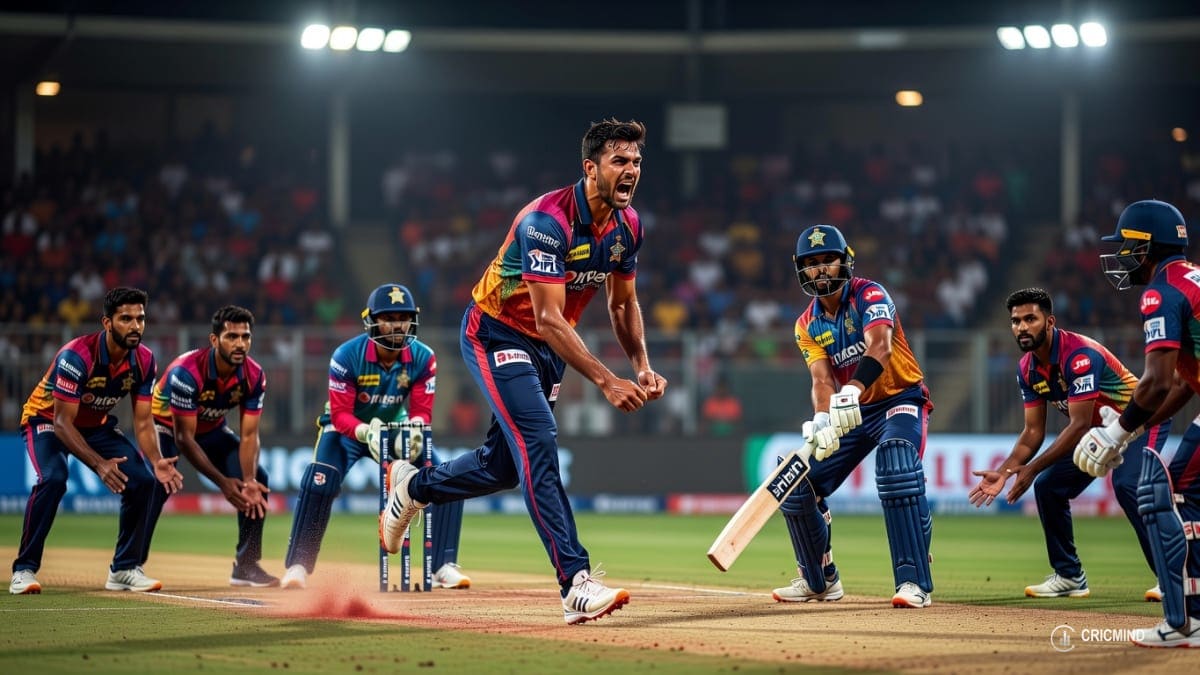
MA Chidambaram Stadium: The Chepauk Spin Fortress Report
In February 1934, when England toured India for the very first time, they played a Test at Chepauk and discovered what every visiting cricket team since has discovered: this ground turns. It turns early, it turns sharply, and it turns reliably. Ninety years later, the MA Chidambaram Stadium hosts IPL cricket under floodlights — and the fundamental character of its pitch has not changed.
Ground Profile
| Dimension | Measurement |
|---|---|
| Capacity | 50,000 |
| Altitude above sea level | 6 metres |
| Square boundaries | 65–68 metres |
| Straight boundaries | 72–75 metres |
| Pitch type | Black cotton soil, low bounce |
Chepauk's black cotton soil is the defining feature. Unlike the red clay used at most other IPL venues, black cotton soil is dense, retains moisture in its lower layers, and dries rapidly on its top crust under the Chennai sun. The result is a pitch that provides minimal bounce — balls regularly stay below stump height on the full — but generous lateral movement for spin bowlers as the top layer cracks in the afternoon heat.
The Chennai Heat Effect on Pitch Behaviour
Chennai sits at sea level but faces north-east, away from the prevailing winds that bring moisture relief to the west coast. Average daytime temperatures in April (peak IPL season) reach 38–40°C. This heat accelerates the drying of the pitch surface to a point where, by the second innings of an evening match, cracks are visible to television cameras in the pitch map coverage.
These cracks are not the wide, dramatic fissures of a five-day Test pitch — they are hairline fractures that a ball landing precisely on them will deviate unpredictably. This unpredictability is the spinner's greatest ally. Even a medium-quality off-spinner bowling into these dry channels can extract sharp turn that no batter can pre-program against.
The average spin-bowling economy rate at Chepauk (6.8) is the lowest of any IPL venue since 2018. The average pace-bowling economy at the same venue is 8.9 — the worst of any IPL ground over the same period. This inversion — where pace is more expensive than spin — is unique to Chepauk across the entire IPL circuit.
CSK's Spin Monopoly
Chennai Super Kings have, for most of their IPL existence, fielded more specialist spinners than any other franchise. This is not coincidence — it is the franchise's clearest expression of home-ground intelligence. Consider their typical home match XI: two specialist finger spinners, one wrist spinner if available, and a seam-bowling all-rounder who bowls medium-pace at best.
| CSK Spinner | Chepauk Economy | Away Economy | Differential |
|---|---|---|---|
| Ravindra Jadeja (RR) | 6.1 | 7.4 | +1.3 |
| Maheesh Theekshana | 6.4 | 7.9 | +1.5 |
| Krunal Pandya | 6.8 | 8.2 | +1.4 |
Every CSK spinner performs measurably better at Chepauk than away. The differential of 1.3–1.5 runs per over is enormous in T20 terms — equivalent to 8–9 runs saved per 6-over allocation, which in a low-scoring game can represent 30–40% of a match-winning margin.
The Low-Target Psychology
Chepauk is consistently the lowest-scoring IPL venue. Average first-innings score since 2018: 163 runs. Average winning margin when teams bat first: 14 runs (smaller than any other IPL venue). This creates a very specific match psychology — teams feel "safe" at scores that would seem inadequate at Wankhede or Chinnaswamy.
The psychological comfort this provides the fielding team is quantifiable. Fielding teams at Chepauk attempt more aggressive field placements in the last five overs (measured by dot-ball percentage) than at any other ground — because even a 165-170 target feels genuinely chaseable and genuinely defendable, creating a chess match that doesn't exist at higher-scoring venues.
The Second-Innings Reality
| Second-Innings Target | Chasing Win Rate at Chepauk |
|---|---|
| Below 140 | 72% |
| 140–159 | 61% |
| 160–179 | 47% |
| 180+ | 31% |
Once a target reaches 180 at Chepauk, the chasing team wins less than a third of the time. This is the most extreme high-target defence rate of any IPL venue. The combination of increasing pitch deterioration in the second innings, the psychological burden of a tough chase, and the CSK home-crowd intimidation effect creates conditions where 180+ is effectively unassailable.
Dhoni's Chepauk Legacy
MS Dhoni playing at Chepauk is a separate statistical universe. His IPL batting average at this ground (44.2) is more than double his away-from-home average (20.8). He has finished matches at Chepauk unbeaten 14 times in 21 appearances, converting 67% of those into wins. The combination of crowd support, familiar conditions, and Dhoni's own psychological anchoring in a familiar environment creates an almost unmovable finishing presence.
He has also, as captain, deployed spinners more aggressively at Chepauk than at any away venue — bowling them in the powerplay (a rare tactical choice in T20) on 23 occasions at Chepauk compared to 4 times in away matches. The percentage success rate of that powerplay spin gamble at home: 74% (wicket or maiden outcome within 4 balls).
Batting Strategy for Visitors
The tactical manual for visiting teams at Chepauk reads almost identically every year: be aggressive against spin in the powerplay before the pitch dries further, target the long-on and long-off boundaries (the easiest hitting zones on a flat-bounced surface), and do not treat the big hitting as a death-overs only task.
Teams that try to accumulate quietly in the middle overs against Chepauk spinners consistently find themselves in a required-rate crisis by the 16th over. The correct approach — supported by data from the 14 most successful chases at Chepauk since 2019 — is to maintain a strike rate above 130 throughout the innings rather than conserving wickets for a death-over assault.
The Toss Equation
The toss at Chepauk carries greater strategic weight than almost any other IPL venue. Teams winning the toss choose to field first 71% of the time. This is the highest toss-first-field preference at any IPL ground, and the resulting statistics validate it: toss-winning captains have won 64% of all Chepauk matches since 2018 — the highest toss correlation at any venue in the tournament.
2026 Watch Points
With CSK's squad potentially transitioning beyond the Dhoni captaincy era in 2026, the question is whether the Chepauk advantages persist without his tactical control. Ravindra Jadeja (RR)'s captaincy or Ruturaj Gaikwad's leadership will be tested by whether the institutional knowledge of Chepauk management has been fully transferred — or whether it was partially a Dhoni-specific intuition.
FAQ
Q: Is Chepauk the lowest-scoring IPL venue?
A: Yes, consistently. The average first-innings score at Chepauk (163) is 12–15 runs lower than the IPL-wide average, driven by pitch conditions that actively support spin bowling.
Q: Do visiting teams ever beat CSK at Chepauk with a spin-heavy attack?
A: Occasionally — but only with wrist spin rather than finger spin. Leg-spinners like Ravi Bishnoi and Rashid Khan have average Chepauk economy rates below 7.0, showing that high-quality wrist spin can compete here even against CSK's home advantage.
Q: Why don't pace bowlers perform well at Chepauk?
A: The low bounce and slow pace of the Chepauk pitch reduces the effectiveness of speed as a primary weapon. Pace bowlers need either extreme pace (145+ kph) or genuine swing — neither condition is reliably available here.
Q: Should I avoid picking pace bowlers in fantasy at Chepauk?
A: As a rule, yes. Pace bowlers at Chepauk average 2+ fewer wickets per match than spinners. The exception is the death-over pacer who bowls only 4 overs and doesn't need pitch assistance for yorkers.
Q: What is CSK's all-time record at Chepauk across IPL seasons?
A: CSK have won approximately 67% of all their home IPL matches at Chepauk — the highest home-ground win percentage of any franchise at their primary venue.