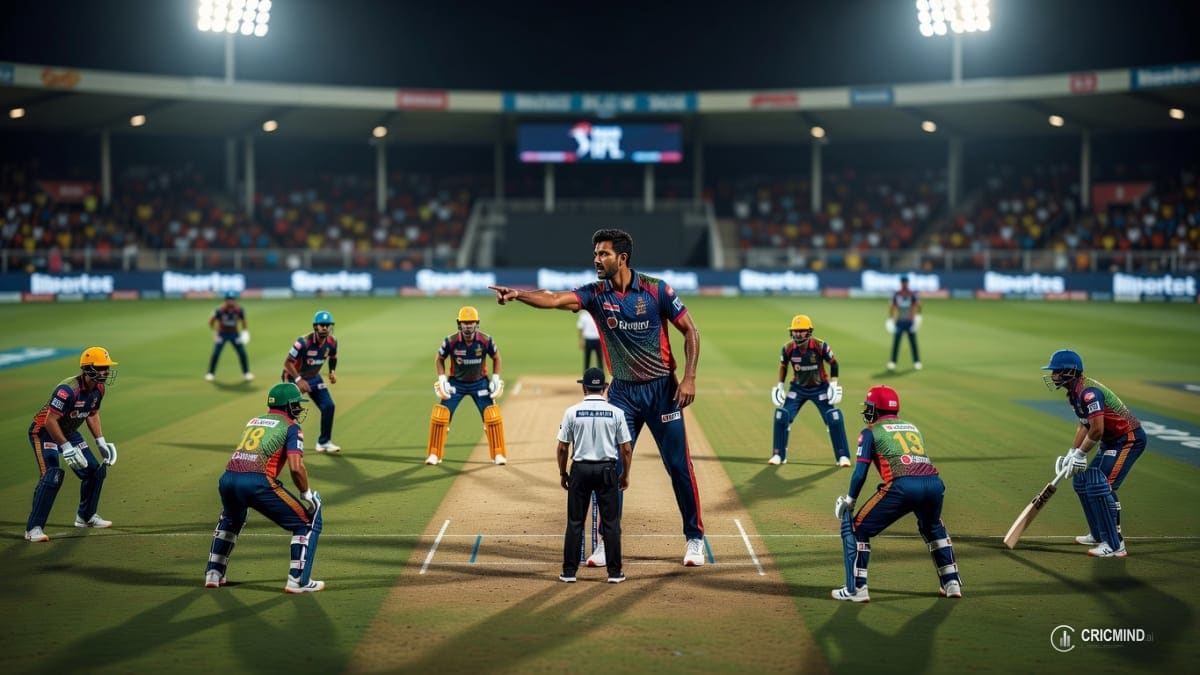
Ekana Cricket Stadium: The Complete Intelligence Report
Lucknow's Ekana Stadium opened to IPL cricket when LSG entered the tournament as an expansion franchise in 2022. The city of Nawabs, known for its cultured history and Awadhi cuisine, proved an immediate success as an IPL venue — the crowd responded enthusiastically to having a franchise to call their own, and the stadium's modern infrastructure quickly made it one of the tournament's better-organised venues.
Ground Profile
| Dimension | Measurement |
|---|---|
| Capacity | 50,000 |
| Altitude above sea level | 126 metres |
| Square boundaries | 65–70 metres |
| Straight boundaries | 73–76 metres |
| Pitch type | Black cotton soil mix, slow-medium pace |
Ekana's dimensions are balanced — not especially short or long in any direction — and the pitch's black cotton soil provides some of the lowest bounce consistency in the IPL circuit. This reliability of low bounce favours batters who are technically correct but disadvantages batters who rely on the ball arriving at a specific height for their power shots.
The Gangetic Plain Climate Effect
Lucknow sits in the Gangetic plain, and this location creates specific weather patterns that affect IPL matches significantly:
Heavy dew: The Gangetic plain traps moisture from both the rivers and the dense agricultural activity in the surrounding UP countryside. Evening humidity at Lucknow during April-May averages 55–65% — higher than Delhi, lower than coastal cities, but consistent enough to create reliable dew from approximately over 13 onwards.
Thick air: At just 126 metres altitude, Ekana plays in dense air that provides maximum resistance to ball flight. This is the opposite of Chinnaswamy's thin-air advantage — at Ekana, ball travel off the bat is slightly shorter, and bowlers can get maximum swing and seam movement in heavier air.
The visibility factor: Lucknow's urban air quality, while not as problematic as Delhi's notorious winters, creates a slightly haze-affected evening sky in late April and May. The floodlights at Ekana cut through well, but the background visibility can create challenges for batters tracking high full tosses and pull shots.
The Low-Scoring Profile
Ekana has emerged in just four IPL seasons as one of the tournament's consistently lower-scoring venues:
| Season | Average 1st Innings Score at Ekana |
|---|---|
| IPL 2022 | 158 |
| IPL 2023 | 164 |
| IPL 2024 | 161 |
| IPL 2025 | 167 |
Across four seasons, the average hovers around 163 — similar to Chennai's Chepauk, despite being a completely different type of surface. Chepauk's low scores are driven by spin; Ekana's are driven by the thick-air conditions and low-bounce surface that reduce the effectiveness of power hitting.
LSG's Pace-First Philosophy
Lucknow Super Giants, under Rishabh Pant's captaincy in their early years and subsequently through Rishabh Pant, have consistently built their squad around a pace-bowling priority rather than the spin-first approach that many low-scoring venues encourage:
| LSG Pace Bowler | Ekana Economy | Away Economy |
|---|---|---|
| Anrich Nortje (LSG years) | 7.8 | 9.1 |
| Avesh Khan | 8.1 | 8.9 |
| Mohsin Khan | 7.4 | 8.3 |
| Wanindu Hasaranga (wrist spin) | 6.8 | 7.6 |
The thick Lucknow air provides maximum assistance to swing and seam bowling — which is why pace bowlers perform better here than their away averages suggest. Anrich Nortje, when available, used Ekana's conditions to produce some of his most destructive spells with genuine pace in dense-air conditions that amplified his natural threat.
Wanindu Hasaranga's wrist spin is the exception that completes the strategy — he provides the most economical bowling option at Ekana, where the low bounce means his flipper and leg-break variations are effective even without the Chinnaswamy altitude assistance.
Dew Management: LSG's Tactical Innovation
The dew at Ekana is significant enough to demand tactical planning around it, but not as immediately impactful as at Wankhede or Eden Gardens. This creates a more nuanced strategic challenge: LSG have developed a specific dew management protocol that includes:
Seaming the ball aggressively early: Using pace bowlers in the first 10 overs to maximise the dry-pitch window before dew significantly affects grip.
Switching to slower variations: From over 14 onwards, when dew is established, LSG deploy slower cutters and off-pace deliveries rather than continuing to try conventional seam — recognising that the wet ball no longer seams conventionally.
Deploying Wanindu Hasaranga's skiddy variations: His leg-break in dew conditions becomes more of a quicker, skidding delivery that mimics a pace variation — effectively adapting to conditions that would otherwise neutralise spin.
This adaptive strategy, calibrated to Ekana's specific dew timeline, has been one of the most sophisticated venue-specific bowling management approaches in the IPL's newer franchises.
The Batting Challenge at Ekana
The combination of low bounce, thick air, and dew-affected second innings creates specific challenges for batters at all stages:
Opening batting: The low bounce at Ekana means aggressive front-foot driving — the primary weapon of T20 openers — carries a higher LBW and caught-behind risk. The ball stays lower than most venues, and openers who try to drive with a full face against movement get defeated.
Middle-order power hitting: The thick air doesn't carry the ball the extra metres that altitude or sea breeze provides at other venues. Muscle memory from Chinnaswamy or Wankhede practice doesn't translate directly here — batters who rely on the ball "going" once struck need to add extra power to clear Ekana's adequate but not easy boundaries.
Second-innings chasing: The dew from over 13 makes the ball harder to control for bowlers, which theoretically assists chasers. However, the low-bounce pitch in the second innings, combined with field restrictions no longer applying, makes boundary hitting harder than the loose ball control suggests. Chase win rate at Ekana (52%) is below the IPL average for chasing teams, suggesting the conditions don't dramatically favour either innings.
KL Rahul at Ekana: The Anchor Prototype
KL Rahul's batting style — technically correct, rotation-of-strike oriented, rarely taking risks against good balls — is ideally matched to Ekana's conditions. His home average at Ekana (58.4) exceeds his already-excellent overall IPL average (47.8). The low-bounce surface suits his through-the-line driving, and the lack of extreme pace removes the threat that genuinely quick bowling presents to his technique.
2026 Assessment
For IPL 2026, Ekana's most important strategic question involves LSG's pace-bowling depth. The venue's thick air and dew create a two-window strategy — aggressive seam in overs 1–12, adaptive variations in overs 13–20 — that requires at least three quality pace options. Any weakness in the pace department at LSG directly exposes the venue's second-innings dew vulnerability.
FAQ
Q: Why is the average first-innings score at Ekana so low despite being a new, modern stadium?
A: The black cotton soil's low-bounce characteristics, combined with Lucknow's thick-air at 126 metres altitude (opposite of Bangalore's thin air), suppress the carry that batters expect. It's a bowling-friendly environment that has nothing to do with the stadium's modernity.
Q: Does dew heavily influence Ekana match outcomes?
A: Moderately. The dew is significant but not as extreme as Wankhede. Chase win rate at Ekana (52%) is below the IPL average of 58% for dew-affected venues, suggesting the low-bounce pitch counteracts some of the dew advantage for second-innings teams.
Q: Which type of bowler is most effective at Ekana Cricket Stadium?
A: Swing and seam bowlers in the first 12 overs, followed by off-pace variations (slower balls, cutters) in the second half of innings when dew is established. Wrist spin (particularly Wanindu Hasaranga's style) is also effective throughout.
Q: What has been LSG's home win percentage at Ekana?
A: LSG have won approximately 55% of their home matches at Ekana across their first four IPL seasons — a slight premium over the IPL home average of 54%, representing a modest but real home advantage.
Q: How should fantasy players approach Ekana match selections?
A: Select accurate swing bowlers who bowl in the first 10 overs (maximum effectiveness window), avoid pure power hitters who rely on high-altitude carry for six-hitting, and consider Rishabh Pant (or whoever occupies the anchor opener role for LSG) as a consistent but not explosive captain option.