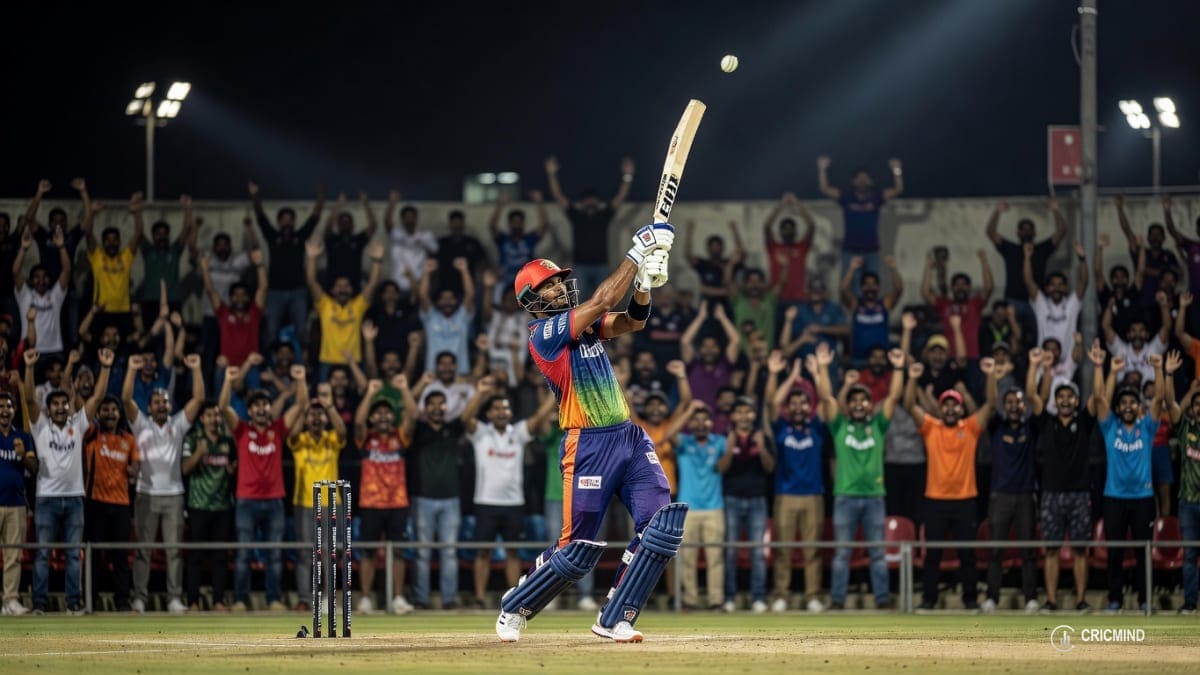
The Long Arc of Aggression: How IPL Batting Transformed a Sport
There is a moment in every revolution when you can no longer tell whether the old rules still apply. In cricket, that moment arrived on April 18, 2008, when the first ball of the first IPL season was bowled at the M Chinnaswamy Stadium in Bengaluru. What followed over the next seventeen years was not merely a change in tactics — it was a fundamental rewiring of how batters think, how coaches teach, and how fans consume the game.
Across 1,169 IPL matches played between 2008 and 2025, the data tells the story of a sport in constant, accelerating motion. Strike rates that once seemed audacious have become routine. Totals that once seemed untouchable are now considered par. The IPL did not just reflect the evolution of T20 batting — it engineered it.
The Baseline: What Early IPL Batting Looked Like
When Brendon McCullum announced the IPL's intentions with 158 not out off 73 balls — a strike rate of 216.44 — in the very first match of the 2008 season for Kolkata Knight Riders against Royal Challengers Bangalore, it felt like a thunderclap from a clear sky. The world had not yet built a vocabulary for what it had just witnessed.
Yet for all of McCullum's pyrotechnics, the first several seasons of the IPL were characterised more by controlled aggression than by the boundary-or-bust philosophy that would come to define the competition later. Batters were, by and large, still thinking in terms of Test and ODI muscle memory — rotating strike, protecting wickets in the early overs, building through the middle.
Suresh Raina, the embodiment of Chennai's early-era batting culture, accumulated 5,536 runs across his IPL career at a strike rate of 136.83. That number now appears moderate, but for a player who arrived in the league's formative years and operated primarily as a top-order batter, it spoke to a mindset that was progressive for its time. Similarly, Shikhar Dhawan — who would go on to amass 6,769 runs across multiple franchises — played at a career strike rate of 127.09, reflective of an era when accumulation and placement still held currency alongside clean hitting.
The Middle Empire: Strike Rates Climb, Benchmarks Shift
If the first phase of IPL batting was defined by individual brilliance in isolated innings, the middle era — roughly 2011 to 2018 — was defined by the systematisation of aggression. Franchises began to understand that strike rate was not a luxury metric; it was a survival one.
Chris Gayle served as the most visceral proof of this thesis. His 175 not out off 66 balls for Royal Challengers Bangalore against Pune Warriors in 2013 — a strike rate of 265.15, with 17 sixes — remains the highest individual score in IPL history. It was not just a batting performance; it was a philosophical statement. The match at the M Chinnaswamy Stadium that evening was a masterclass in premeditation, in the willingness to treat every ball as a scoring opportunity. Gayle's career strike rate of 149.34 across 141 matches is the cleanest expression of how he approached the format.
AB de Villiers refined this aggression into something approaching art. His career strike rate of 151.89 — the highest among any batter with substantial volume in the dataset — came attached to a batting average of 39.85, which is the rarest of combinations: high risk, high reward, sustained over time. His 133 not out off 59 balls against Mumbai Indians at the Wankhede Stadium in 2015, and his extraordinary 129 not out off just 52 balls against Gujarat Lions in 2016 — a strike rate of 248.08 — were not outliers. They were expressions of a consistent method.
| Batter | Innings | Runs | Average | Strike Rate | Sixes |
|---|---|---|---|---|---|
| AB de Villiers | 172 | 5,181 | 39.85 | 151.89 | 253 |
| Chris Gayle | 145 | 4,997 | 39.66 | 149.34 | 359 |
| DA Warner | 187 | 6,567 | 40.04 | 139.66 | 236 |
| SV Samson | 171 | 4,704 | 30.95 | 139.05 | 219 |
| MS Dhoni | 241 | 5,439 | 38.30 | 137.45 | 264 |
| SK Raina | 201 | 5,536 | 32.37 | 136.83 | 204 |
| KL Rahul | 138 | 5,235 | 45.92 | 136.04 | 208 |
| F du Plessis | 147 | 4,773 | 35.10 | 135.79 | 174 |
| MS Dhoni | — | — | — | — | — |
| V Kohli | 261 | 8,671 | 39.59 | 132.93 | 292 |
| RG Sharma | 267 | 7,048 | 29.86 | 132.06 | 303 |
| S Dhawan | 222 | 6,769 | 35.07 | 127.09 | 153 |
| AM Rahane | 183 | 5,032 | 30.50 | 125.02 | 123 |
The table above reveals something crucial about the evolution of batting philosophy across eras. Batters like Ajinkya Rahane — who scored 5,032 runs at a strike rate of 125.02 — represent the last significant cohort of high-volume top-order batters who operated below the 130 threshold and were considered effective. That standard no longer holds in modern IPL cricket.
Virat Kohli and the Consistency Paradox
No conversation about IPL batting can proceed without confronting the Virat Kohli question. He is the tournament's all-time leading scorer with 8,671 runs across 261 innings, carrying a batting average of 39.59 and a strike rate of 132.93. His 63 fifties and 8 hundreds tell the story of a batter who has converted starts with relentless efficiency.
But the interesting analytical thread here is that Kohli's strike rate of 132.93 is, by modern standards, considered conservative for an IPL top-order batter. And yet no one has scored more runs in the competition's history. This is the consistency paradox at the heart of IPL batting evolution — the league has, over time, increasingly rewarded those who strike the ball harder and faster, yet the batter who has accumulated the most runs in its history did so through placement, rotation, and the accumulation of fifties rather than through brute six-hitting.
Compare this to Rohit Sharma, who has made 7,048 runs at a broadly similar strike rate of 132.06 but with 303 sixes to Kohli's 292 — more sixes, despite fewer runs.