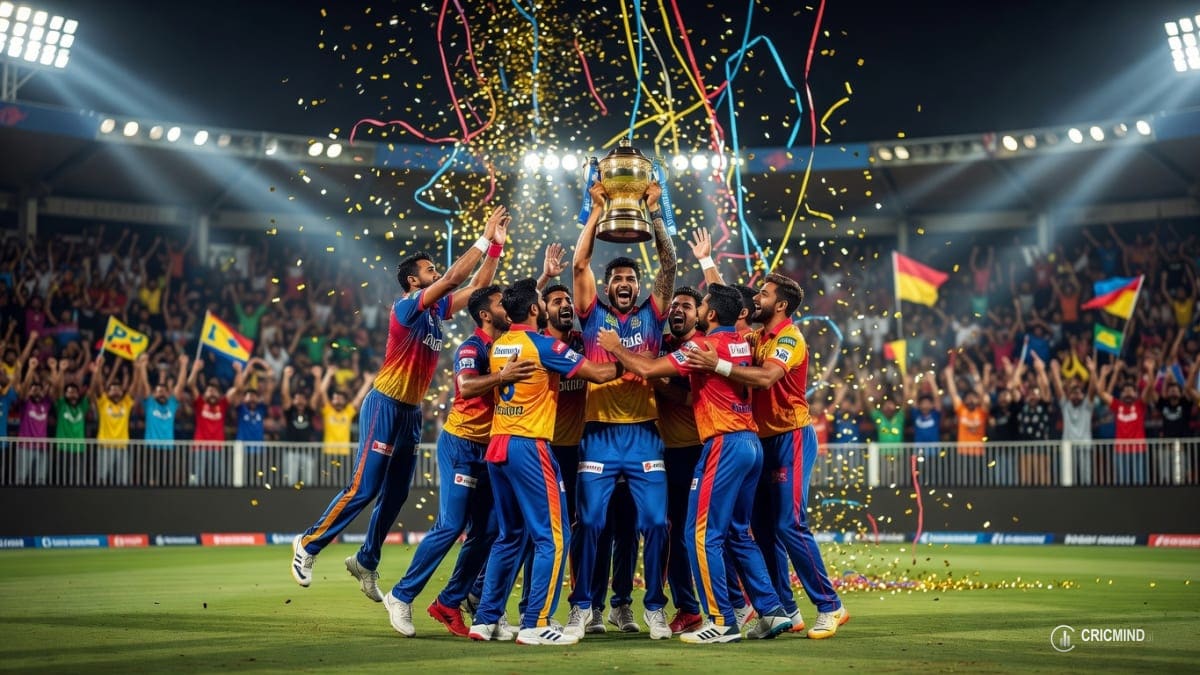
From Last to Champions in One Year
Deccan Chargers finished last in IPL 2008 — 8th out of 8 teams, with 4 wins from 14 matches. Twelve months later, they were IPL champions. The turnaround is the most dramatic single-season improvement in the tournament's history and one of the most remarkable reversals in T20 cricket.
The 2008 Chargers were a team of contradictions: expensive (purchased for $107 million, the fourth-highest price in the original auction), star-laden (VVS Laxman, Andrew Symonds, Rohit Sharma), and yet fundamentally mismanaged. The squad had no clear batting order, no settled bowling combination, and a captain — V.V.S. Laxman — who was a magnificent Test batter entirely unsuited to T20 captaincy.
The 2009 Chargers solved all three problems simultaneously.
The Transformation: Three Key Changes
Change 1: Adam Gilchrist as captain and opener. Gilchrist had been underused in 2008 — batting at number 4, hampered by injuries, and constrained by Laxman's cautious captaincy philosophy. When Gilchrist was given the captaincy and allowed to open, everything changed. His 495 runs in 2009, scored at a strike rate of 153.7, set the template for the powerplay assault that would define Deccan's campaign.
Change 2: Herschelle Gibbs as the second opener. The South African veteran, then 35 years old and widely considered a spent force, scored 381 runs in 2009 at a strike rate of 157.2. The Gilchrist-Gibbs opening partnership — two veteran destroying machine batters who had absolutely nothing to lose — averaged 52.3 across their 16 shared innings, the highest opening partnership average in that season.
Change 3: The bowling attack around Pragyan Ojha. Ojha's left-arm spin took 18 wickets in the 2009 tournament at an economy rate of 6.4 — exceptional numbers that anchored a bowling attack also featuring Andrew Symonds, Rohit Sharma (before his move to MI), and the express pace of Chaminda Vaas and R.P. Singh.
The 2009 Season in Numbers
| Metric | Value |
|---|---|
| League stage position | 4th (barely qualified) |
| Total matches | 16 |
| League stage record | 9 wins, 7 losses |
| Top scorer | Adam Gilchrist — 495 runs |
| Top wicket-taker | Pragyan Ojha — 18 wickets |
| Final vs | RCB |
| Final score | DC 143/6, RCB 137/9 |
| Final result | Won by 6 runs |
The tournament was held in South Africa in 2009, a second home for many of the Deccan players who had played in the Proteas' domestic competition. The unfamiliar South African conditions contributed to lower scoring across the tournament — the average first-innings score in IPL 2009 South Africa was 143, compared to 155 in IPL 2008 India.
The Final: A Six-Run Thriller
The 2009 final against Royal Challengers Bangalore at Wanderers Stadium in Johannesburg was defined by bowling. Deccan posted 143/6 — modest by any standard. RCB, with Virender Sehwag, Kevin Pietersen, and Jacques Kallis in their batting order, should have chased it comfortably.
Pragyan Ojha bowled magnificently, and RP Singh's aggressive pace in the powerplay restricted RCB early. The final ball arrived with RCB needing 4 to win. Chaminda Vaas bowled it. RCB managed 3. Deccan won by a single run that had no meaningful context beyond one of the most dramatic finishes in a cricket final at that point in history.
The Four-Year Decline and Termination
The 2009 championship was Deccan Chargers' peak. They never won another playoff match. The franchise finished 5th in 2010, last again in 2011, and bottom in 2012 — completing a circle back to where they had started before their miraculous 2009 season.
The parent company, Deccan Chronicle Holdings Limited, accumulated crippling debts. Player payments were delayed repeatedly in 2012. The BCCI, after formal warnings, terminated the franchise in September 2012 under the franchise agreement's financial default clauses. Deccan Chargers were the first franchise to be forcibly removed from the IPL.
The players were distributed in a draft to the other franchises. Sunrisers Hyderabad, awarded the Hyderabad franchise in October 2012, retained several key Chargers players and eventually won the IPL title in 2016 — the only other team from Hyderabad to win the championship.
Why 2009 Matters
The Deccan Chargers are now largely forgotten — an asterisk in IPL history, remembered by cricket trivia enthusiasts and largely invisible to fans who joined the IPL universe after 2015. This is an injustice to one of cricket's most remarkable one-year stories.
More practically, the 2009 campaign stands as proof that one inspired captaincy appointment can transform an IPL team from wooden spoon to champion in twelve months. Gilchrist's appointment was not just a cricketing decision — it was a philosophical one. The Chargers decided to build their identity around their most destructive batter and let everything else follow. In 2009, it worked perfectly.
FAQ
Q: Who won IPL 2009?
Deccan Chargers won IPL 2009, defeating Royal Challengers Bangalore by 6 runs in the final played at Wanderers Stadium in Johannesburg, South Africa. Adam Gilchrist captained the team.
Q: Why was the 2009 IPL held in South Africa?
IPL 2009 was moved to South Africa because it clashed with the Indian general elections, which required large-scale police deployment that made securing IPL venues in India impractical. It was the only IPL edition held outside India or the UAE until the 2020 COVID season in UAE.
Q: What happened to Deccan Chargers?
Deccan Chargers were terminated by the BCCI in September 2012 due to financial irregularities and the parent company's inability to pay player salaries. Their franchise slot was awarded to the Sunrisers Hyderabad for the 2013 season.