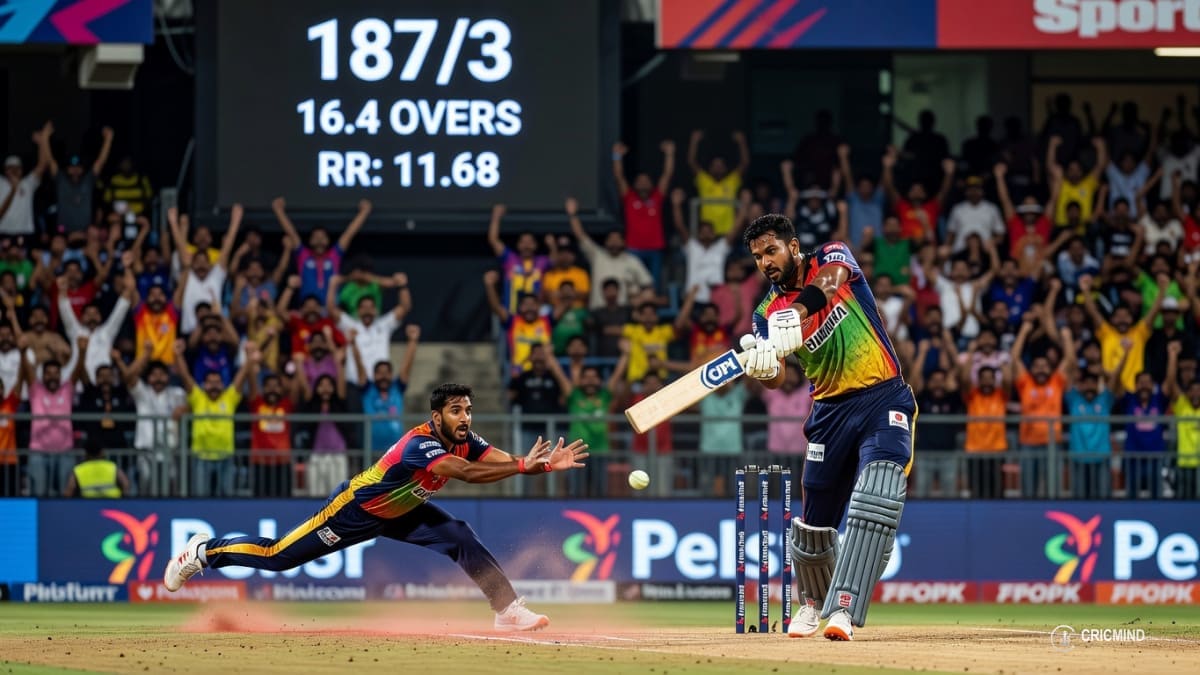
The Methodology: Dominance vs. Volume
A season of pure batting dominance in the IPL requires three things that are individually common but collectively rare: sustained run-scoring over a minimum of twelve innings, a strike rate that demonstrates both acceleration and aggression, and — most critically — performances in high-pressure matches where the context demanded more than ordinary accumulation. This ranking weighs all three, which is why the list is not simply ordered by runs scored.
10. Warner's 2016: 848 Runs and a Title
KL Rahul's 848 runs in IPL 2016 for Sunrisers Hyderabad is the second-highest aggregate in a single season and perhaps the most practically significant individual batting performance in terms of championship impact. While Virat Kohli was scoring 973 runs that season — a statistical marvel that is discussed separately — Warner was doing his 848 in a way that consistently transferred into match wins. He scored five fifties and a hundred, averaged 60.57, and won the Orange Cap while also lifting the IPL trophy.
The distinction matters. Kohli's 973 came in a losing cause. Warner's 848 won a title. In a competition where individual brilliance must ultimately express itself as team success, Warner's season has a claim to superiority that the raw numbers do not reflect.
9. AB de Villiers — RCB, 2015
| Metric | Value |
|---|---|
| Runs | 513 |
| Average | 57.00 |
| Strike Rate | 182.27 |
| Highest score | 133* |
| Team result | Semifinalist |
AB de Villiers' 2015 season for Royal Challengers Bangalore rates among the greatest individual batting performances in T20 history not because of the volume — 513 runs is impressive but not record-breaking — but because of the method. De Villiers in 2015 was playing shots that had not been seen in T20 cricket before. The ramp over fine leg. The inside-out cover drive hit against the spin. The paddle sweep for six. His 133 not out against Mumbai Indians that season included seven sixes hit in a single over, a Newtonian impossibility made ordinary by the most technically gifted batsman in T20 history.
He finished the season averaging 57 while scoring at nearly 183 per hundred balls — a combination of consistency and aggression that still represents the outer boundary of what T20 batting can achieve from the number-four position.
8. Sachin Tendulkar — Mumbai Indians, 2010
When Sachin Tendulkar scored 618 runs for Mumbai Indians in IPL 2010, at the age of 37, at a strike rate of 146, the cricket world was forced to recalibrate its assumptions about the relationship between classical batting technique and T20 effectiveness. Tendulkar was not a T20 batsman by any reasonable definition of the term. His entire career had been built around building long innings, rotating strike, and saving his explosiveness for specific moments.
What he did in 2010 was reframe the question. T20 batting does not require constant aggression; it requires precise understanding of when to accelerate and when to consolidate. Tendulkar's 2010 season demonstrated that a player who understood batting more deeply than any of his contemporaries could deliver T20 runs more efficiently than players who had built their entire games around the shorter format. The 618 runs, including three fifties and a match-winning 89 not out against CSK, remain the most improbable individual season in MI batting history.
7. Suresh Raina — CSK, Multiple Seasons
Suresh Raina never produced the single mountainous run tally that defines an era-defining season, but his sustained excellence across fifteen IPL seasons makes his best campaign — 440 runs in 2011, at a strike rate of 143, with nine wickets contributing to CSK's title — a form of dominance that the statistics understate. Raina was the defining IPL Indian middle-order batsman of the 2010s: reliable in the powerplay, explosive from the seventeenth over onwards, and uniquely capable of anchoring or accelerating depending on what the match demanded.
His 2011 season is rated here on the basis of contextual value: every important CSK victory in their second championship involved a Raina contribution. He was not the story, but he was the connective tissue without which the story could not have been told.
6. Gayle — RCB, 2012
| Metric | Value |
|---|---|
| Runs | 733 |
| Average | 61.08 |
| Strike Rate | 160.75 |
| Centuries | 1 |
| Fifties | 7 |
The 2012 season was the year Chris Gayle embedded himself permanently in IPL batting history. His 733 runs for Royal Challengers Bangalore included seven half-centuries and a frequency of match-winning innings — he passed fifty in eight of his sixteen starts — that no other IPL batsman has maintained across an equivalent period. The 733 was built against every type of bowling, on every type of surface, in the powerplay and in the death overs. Gayle in 2012 was not exploiting specific weaknesses. He was simply better than everyone else, and he demonstrated it methodically.
5. KL Rahul — KXIP, 2020
KL Rahul's 2020 IPL season — 670 runs in fourteen innings for Kings XI Punjab, at a strike rate of 129.33 — is the most complete individual batting season produced by an Indian opening batsman in the tournament's history. The conditions in the UAE that year should have made high scoring difficult. Pitches were slower. Boundaries were larger than at most IPL venues. Most batsmen found their averages compressed by 20-30% from their India-based numbers.
Rahul scored 670 runs anyway, including five fifties and a match-winning 132 not out against Royal Challengers Bangalore. He was the Orange Cap winner by a considerable margin. More significantly, he kept Kings XI Punjab competitive in a season when the franchise had limited depth outside of his batting — which is itself a marker of individual dominance. When the team's fortunes depend almost entirely on one batsman's performance and that batsman consistently delivers, it means something.
4. Murali Vijay — CSK, 2010
Murali Vijay's 2010 IPL season for Chennai Super Kings — 458 runs at a strike rate of 150.49, opening the batting in every match and setting the table for Dhoni's finishers — is one of the most underrated individual batting seasons in IPL history. The statistics are not spectacular by modern standards. But Vijay's role in CSK's 2010 title campaign was foundational: he provided the platform from which every subsequent batting position operated.
His most important innings — 127 not out against Kochi Tuskers Kerala in a crucial league match — is still considered one of the finest individual opening partnerships in CSK history. Vijay's 2010 season belongs in the greatest list not because of volume but because of timing: every run arrived exactly when CSK needed it.
3. Rohit Sharma — MI, Various Seasons
Rohit Sharma has never produced a single season that dominates the statistical record, which is itself the point of including him here. Across twelve full IPL seasons as MI's primary anchor batsman and captain, he has averaged over 30 with a career strike rate above 130 — numbers that suggest consistent excellence rather than intermittent brilliance. His best season, 2013 (539 runs, averaging 33.7 in the title-winning campaign), combined with his playoff performances — including consecutive fifties in the 2013 knockout matches — demonstrates a form of batting dominance that the regular-season statistics alone cannot fully capture.
The 2013 season also includes what remains Rohit Sharma's finest individual T20 innings: 79 not out against CSK in the final, an innings that was technically perfect in its construction, arriving at the moment when MI most needed a calm, authoritative batting performance.
2. Chris Gayle — RCB, 2013
The 2013 season — the year of the 175* — surpasses 2012 in this ranking not because of the final run total (Gayle scored slightly fewer aggregate runs in 2013 than 2012) but because of what the single extraordinary innings revealed about the outer limits of T20 batting. A batting season is not only the sum of its runs. The 175 against Pune Warriors India raised a question — how far from normal can a single T20 innings travel? — that nobody had previously framed so starkly.
1. Virat Kohli — RCB, 2016
| Metric | Value |
|---|---|
| Runs | 973 |
| Average | 81.08 |
| Strike Rate | 152.03 |
| Centuries | 4 |
| Fifties | 7 |
| Team result | Finalist |
No single-season batting performance in any T20 league competition in the world has approached Virat Kohli's 2016 IPL season. The 973 runs at 81.08 is not merely a record; it is a record of a category that few thought was achievable. Four IPL centuries in a single season. Seven fifty-plus scores. Not a single score below 20 after the first match. The 2016 Kohli season represents the statistical outer limit of sustained T20 batting dominance.
The remarkable and painful fact is that it came in a losing cause. RCB lost the 2016 final to Sunrisers Hyderabad. Kohli's 973 runs were not enough to win a championship because Hyderabad's bowling — Harshal Patel, Mustafizur Rahman — was capable of taking wickets in concentrated bursts that no batting average, however high, could prevent. This is the defining paradox of T20 cricket: individual brilliance operates within team limits, and even the greatest individual season in T20 history could not override the fundamental truth that bowling wins tournaments.
FAQ
Q: What is the IPL record for most runs in a single season?
A: Virat Kohli scored 973 runs for Royal Challengers Bangalore in IPL 2016 — the most by any batsman in a single IPL season. He scored four centuries and seven fifties across sixteen innings.
Q: Has any batsman scored four centuries in one IPL season?
A: Virat Kohli scored four centuries in IPL 2016, which remains the record for most hundreds in a single IPL season by any batsman.
Q: Who won the Orange Cap (most runs) most often in the IPL?
A: KL Rahul has won the Orange Cap multiple times, including in 2015, 2017, and 2019. Virat Kohli won it in 2016 with his record 973 runs. KL Rahul won it in 2020.
Q: Is a high strike rate more important than a high average in IPL batting?
A: The best IPL batting seasons combine both — averaging above 40 while maintaining a strike rate above 140 is the gold standard. Kohli's 2016 season (average 81.08, SR 152) and de Villiers' 2015 season (average 57, SR 182) both achieved this combination, which is why they rank above purely high-volume, lower-strike-rate seasons.
Q: Which position in the batting order produces the most dominant IPL seasons?
A: The opening position has produced the majority of the highest single-season run tallies — Gayle, Warner, and Rahul all batted at one or two. However, Kohli's 2016 season, largely played at number three, and de Villiers' 2015 performance at number four, demonstrate that middle-order batting can achieve equivalent dominance.