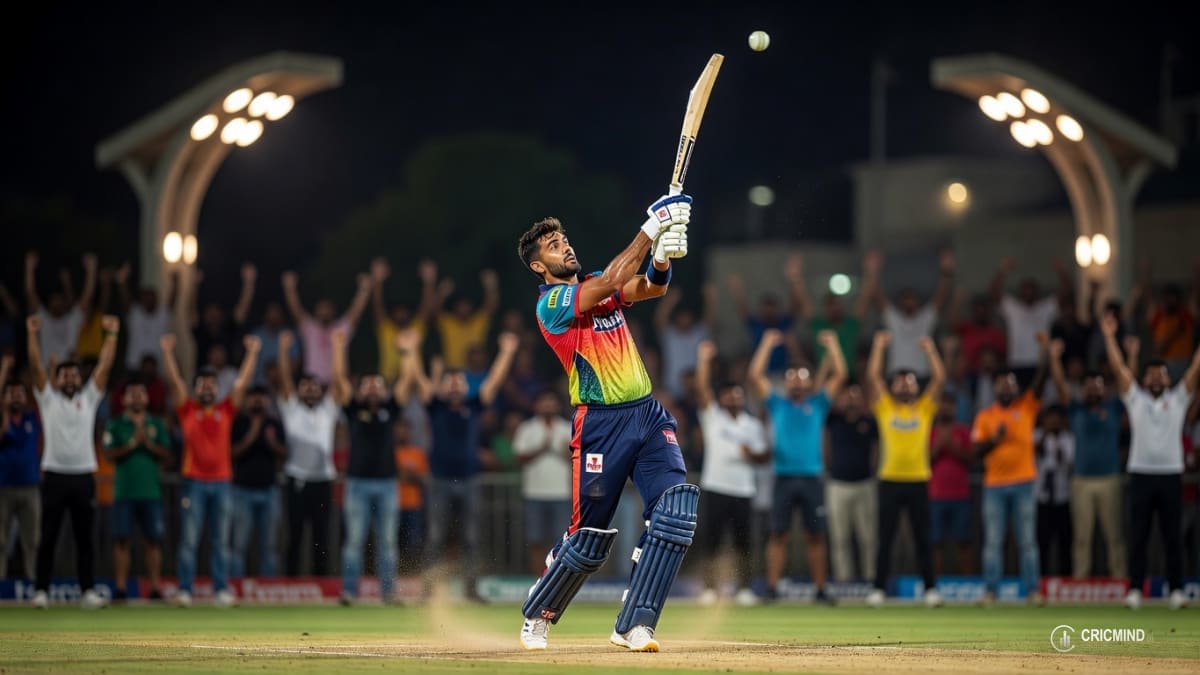
The Invisible Architecture of Run-Making
There is a moment in every IPL game that most casual viewers miss entirely. It happens before a single ball is bowled — when the batting order is set, when a captain writes eleven names in a sequence that will determine, more than almost any other decision, how many runs his side will score. The batting position is not a number. It is a contract. A set of responsibilities, a window of opportunity, and a measure of trust.
Across 1,169 IPL matches spanning 2008 to 2025, that contract has been tested, broken, rewritten, and occasionally honoured with breathtaking brilliance. This is a deep look at what batting position actually means in the IPL — who has mastered it, which roles produce the most value, and why the best teams treat their batting order as a strategic document rather than a formality.
Position 1 and 2: The Foundation and the Freedom
Opening the batting in T20 cricket is, paradoxically, the most and least pressurised role simultaneously. The field restrictions are yours to exploit. The bowling is fresh but the fielders are hemmed in. The data from this era tells that story with remarkable clarity.
Virat Kohli and David Warner are the two defining opening batsmen of the IPL generation, and the contrast in how they built value is instructive.
| Batsman | Matches | Runs | Average | Strike Rate | Hundreds | Fifties |
|---|---|---|---|---|---|---|
| V Kohli | 259 | 8,671 | 39.59 | 132.93 | 8 | 63 |
| DA Warner | 184 | 6,567 | 40.04 | 139.66 | 4 | 62 |
| S Dhawan | 221 | 6,769 | 35.07 | 127.09 | 2 | 51 |
| CH Gayle | 141 | 4,997 | 39.66 | 149.34 | 6 | 31 |
Kohli's 8,671 runs are the most in IPL history, a number that belongs not just to talent but to positional mastery. He understood, earlier than almost anyone, that an opener's job is not simply to go fast — it is to anchor phases while accelerating within them. His average of 39.59 at a strike rate of 132.93 reflects that duality: the man who could play Powerplay aggression and then steer an innings through the middle overs when wickets fell.
Warner brought something different to the top of the order — a predatory urgency, a strike rate of 139.66 that consistently put opposition bowlers under pressure from the first over. In 184 matches, he accumulated 6,567 runs with an average of 40.04, making him arguably the most consistent overseas opener the tournament has seen. His 62 fifties in 187 innings tell you he was not a gambler; he was a craftsman who simply operated at a higher tempo than most.
Shikhar Dhawan, across four franchises over seventeen seasons, brought 6,769 runs to the top of the order — a number that deserves far more reverence than it typically receives. His 127.09 strike rate was lower than Warner's, but his 35.07 average across 222 innings reflects remarkable consistency across radically different team environments.
And then there is Chris Gayle. The Universe Boss did not open an innings — he detonated it. His 149.34 strike rate and 6 hundreds in 141 matches represent something that statistics struggle to fully capture: the psychological damage caused simply by his presence at the crease. His 175 against Pune Warriors remains the highest individual score in IPL history, struck off just 66 balls with 17 sixes*, a number that still feels like it belongs to a different sport.
Position 3 and 4: Where Matches Are Made
If opening the batting is about exploiting the Powerplay, batting at three and four is about reading the game and responding to it. These are the positions that reward intelligence as much as power — players who can accelerate off a strong platform or rebuild after early wickets.
KL Rahul has spent much of his career navigating this space, though his exact positioning has shifted across franchises. The numbers he has produced are exceptional by any measure: 5,235 runs at an average of 45.92 — the highest among major IPL batsmen in this dataset — with a strike rate of 136.04. His 5 hundreds and 40 fifties in 138 innings define what elite middle-order consistency looks like. His highest of 132* against Royal Challengers Bangalore is the perfect encapsulation of his range — fluent enough to be beautiful, destructive enough to be devastating.
AB de Villiers made position three or four at Royal Challengers Bangalore feel like an unfair advantage for nearly a decade. His strike rate of 151.89 is the highest among any high-volume batsman in this data, and his 5,181 runs at an average of 39.85 were struck with a creativity that made bowling plans obsolete. Two innings in particular stand as monuments to what a middle-order batsman can do: 133 off 59 balls against [Mumbai Indians](/teams/mumbai-indians) and 129 off just 52 balls against Gujarat Lions — the latter at a strike rate above 248**. These were not innings. They were arguments.
Position 5 and 6: The Engine Room
This is where IPL teams are won and lost in aggregate. The number five and six slots demand something the top order rarely needs: the ability to score quickly with little context, often with wickets already fallen and the asking rate already climbing.
Suresh Raina defined this role for Chennai Super Kings across more than a decade. His 5,536 runs at a strike rate of 136.83 made him the most reliable finisher-accelerator of his generation. The strike rate is revealing — higher than Kohli, higher than Dhawan, reflecting the aggressive intent that positions five and six demand. His 39 fifties in 201 innings prove this was not flash without substance.
MS Dhoni at six (or occasionally seven) for Chennai represents perhaps the most studied batting position in IPL history. The numbers are fascinating precisely because they require interpretation:
| Batsman | Innings | Not Outs | Runs | Average | Strike Rate | Sixes |
|---|---|---|---|---|---|---|
| MS Dhoni | 241 | 99 | 5,439 | 38.30 | 137.45 | 264 |
| SK Raina | 201 | 30 | 5,536 | 32.37 | 136.83 | 204 |
| KD Karthik | 235 | 51 | 4,843 | 26.32 | 135.28 | 161 |
Dhoni's 99 not outs from 241 innings are not a quirk — they are the fingerprint of a finisher who understood his job description with absolute clarity. His highest score of just 84 reflects a man who never confused his role with someone else's. He was not there to make hundreds. He was there to make sure his team did not lose from positions where they should have won. His 264 sixes* from a position where he faced fewer balls than any top-order batsman is a jaw-dropping measure of efficiency.
Dinesh Karthik built a second career on exactly this archetype — the late-innings detonator, the man who could score at 135.28 with 51 not outs in 235 innings, turning himself from a solid journeyman into the definitive IPL finisher of his late career.
The Volume Scorers: What Accumulation Tells Us
When we look at the most prolific run-scorers across all positions, the data reveals something about the relationship between positional stability and run accumulation.