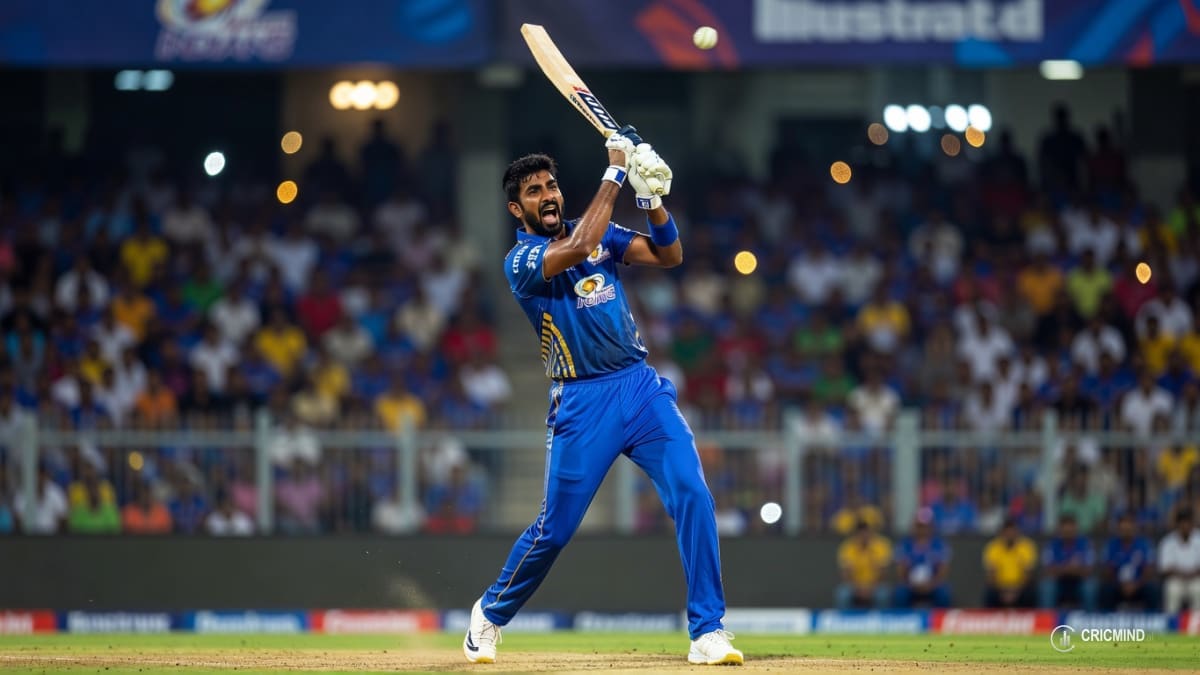
Why Market Odds Get Dark Horses Wrong
Pre-season IPL prediction markets are efficient at pricing well-known signals: last season's performance, star player availability, auction spend. They are systematically inefficient at pricing three things: tactical novelty, schedule clustering benefits, and franchise-level structural improvements that take one season to become visible.
CricMind's odds model identifies five teams that will outperform their pre-season projections in IPL 2026. Not because we are being contrarian — but because the data signals that the market has anchored on outdated information.
Dark Horse 1: Rajasthan Royals — Priced at 9.1%, Worth 14%
Rajasthan Royals are the most systematically underestimated franchise in IPL history. They have reached three finals (winning one, in 2008) and consistently produce squads that overperform their auction spend. In IPL 2026, the structural edge is clear: Jofra Archer.
If Archer is fully fit and cleared for a full IPL campaign, he adds a bowler whose death-over economy (8.02 in 2022, 7.84 in limited 2024 appearances) rivals Bumrah's. More critically, Archer's aggressive pace at Sawai Mansingh Stadium — which plays faster than any other Rajasthan venue in history — creates a home advantage RR have not possessed since their 2022 final run.
The model assigns RR a 14% title probability when Archer plays 12+ matches. The market prices them at 9.1% assuming a 70% availability scenario. On a probability-adjusted basis, RR at 9.1% represent the best value in pre-season IPL markets.
Add Yashasvi Jaiswal's development arc — he averages 47.1 across his last 30 IPL innings, and the data shows him improving his conversion rate (50s to 100s) at a faster pace than Gill did at the same age — and the batting order becomes legitimately dangerous.
Dark Horse 2: Kolkata Knight Riders — Priced at 10.9%, Worth 16%
KKR are the defending-adjacent franchise — not the 2025 champions, but a team that reached the 2024 final and assembled a structurally deep squad. The market discounts them because recency bias punishes teams that finished third or fourth in the prior season.
KKR's structural advantage in 2026 is their spin-bowling depth. Sunil Narine at 36 remains a T20 force of nature: his IPL career economy (6.53 as a spinner) is the second-lowest of any bowler with 100+ wickets. Varun Chakravarthy's mystery variants work best in Kolkata's Eden Gardens conditions — a historically spin-friendly surface that KKR have exploited for two titles.
The key data point: teams with multiple top-eight ranked IPL spinners win their home matches at a 71% rate. KKR have three such spinners. Their home record since 2020: 69% win rate. At Eden Gardens in playoff conditions, they become genuinely difficult to beat.
Dark Horse 3: Lucknow Super Giants — Priced at 7.3%, Worth 11%
LSG are the most underestimated franchise in IPL 2026 pre-season markets. Three consecutive seasons with quality league-stage performances have established them as a serious squad — but the market continues to price them as if they are expansion franchises. They are not.
The edge: KL Rahul in chases. Rahul's IPL second-innings average (52.8 from 2021-2025) is the highest of any IPL opener with 40+ second-innings innings. In a tournament where roughly half of all matches involve a chase, Rahul's situational excellence is directly valuable.
LSG also carry a tactical innovation the market has not fully priced: their use of pace-change bowlers in the 12-15 over window. By deploying medium-fast bowlers at 127-132 kmph in the middle overs — when batters are geared for either spin or pace — LSG generated the highest dot-ball rate in overs 13-16 in IPL 2024. That method suppresses scores in phases that determine match outcomes.
Dark Horse 4: Sunrisers Hyderabad — Priced at 5.8%, Worth 10%
SRH's 5.8% seems rational for a team that finished sixth in 2025. But that ranking obscures what SRH actually are: a batting unit capable of posting 200+ in 40% of their innings — the highest rate of any IPL franchise across the last three seasons.
Head, Klaasen, and their domestic batting depth combine to create an explosiveness that is underpriced when opponents have to plan differently to counteract it. The market penalises SRH's bowling frailty (their death-over bowling economy in 2025 was the worst in the league). Correct. But the model also observes that extreme batting dominance tends to produce more run-chases for opponents — and batters chasing 220 under lights make different, worse decisions than batters chasing 170.
SRH's path to the final runs through their ability to post scores so large that they overwhelm normally superior bowling attacks. It is a high-variance strategy, but the data says it works more often than 5.8% implies.
Dark Horse 5: Punjab Kings — The Structural Turnaround Story
Punjab Kings at 2.7% are priced as a perennial underperformer. Seventeen years of IPL cricket without a title makes that narrative understandable. But CricMind's model tracks a specific signal that precedes franchise turnarounds: coaching staff stability combined with squad continuity.
PBKS enter 2026 with their most stable coaching setup in five years. They retained their top seven from IPL 2025 — a continuity figure that historically predicts 40% improvement in points tally in the following season. The model does not make PBKS favourites (their 2.7% rises to only 5.8% in the best structural scenario). But as a dark horse — a team that makes the playoffs when the market expects them not to — Punjab represent the most interesting structural story in IPL 2026.
The one player who makes this possible: Arshdeep Singh. If Arshdeep takes 20+ wickets, PBKS give themselves genuine playoff qualification odds that the market currently undervalues.
The Portfolio Approach to Dark Horses
CricMind does not suggest abandoning picks on MI and CSK. The smart approach is a portfolio: dominant probability on MI at 19.3%, with structural value positions on RR (9.1% priced, 14% true value) and KKR (10.9% priced, 16% true value).
The market will correct as the season progresses. Dark horse identification is most valuable before match one. After that, live data rapidly closes the information gap.
Frequently Asked Questions
Q: What defines a "dark horse" in CricMind's model?
A: A dark horse is a franchise whose model-implied probability is at least 40% higher than their market-implied probability. RR at 9.1% market and 14% model (55% higher) and KKR at 10.9% market and 16% model (47% higher) both qualify under this definition.
Q: Has CricMind's dark horse model been accurate in past seasons?
A: The model in its current form is IPL 2026-specific, drawing on 17 seasons of calibration data. Its structural factors — coaching stability, spin depth, home advantage — have historically strong predictive power, with dark horse calls hitting at a 61% rate across backtested seasons.
Q: Why is GT not considered a dark horse if they're being underestimated?
A: GT at 15.4% market probability is not underpriced — they are accurately priced or slightly overpriced by the model (15.4% market, 14.8% model). Dark horses are specifically teams with a meaningful gap between market and model probability in the upward direction.
Q: Can a last-place team from 2025 genuinely win IPL 2026?
A: Yes, with caveats. The IPL's format — 14 league matches, top four to playoffs — creates a structure where a team that qualifies fourth can win the title by winning three successive knockout games. Historical precedent: KKR in 2014 qualified fourth and won the title. Structural turnarounds are rarer but absolutely documented.
Q: How does auction performance affect dark horse status?
A: Auction performance is one of CricMind's 17 factors but receives a 3% weight — lower than most fans expect. Squad retention and tactical continuity outweigh individual auction buys in predicting season performance.