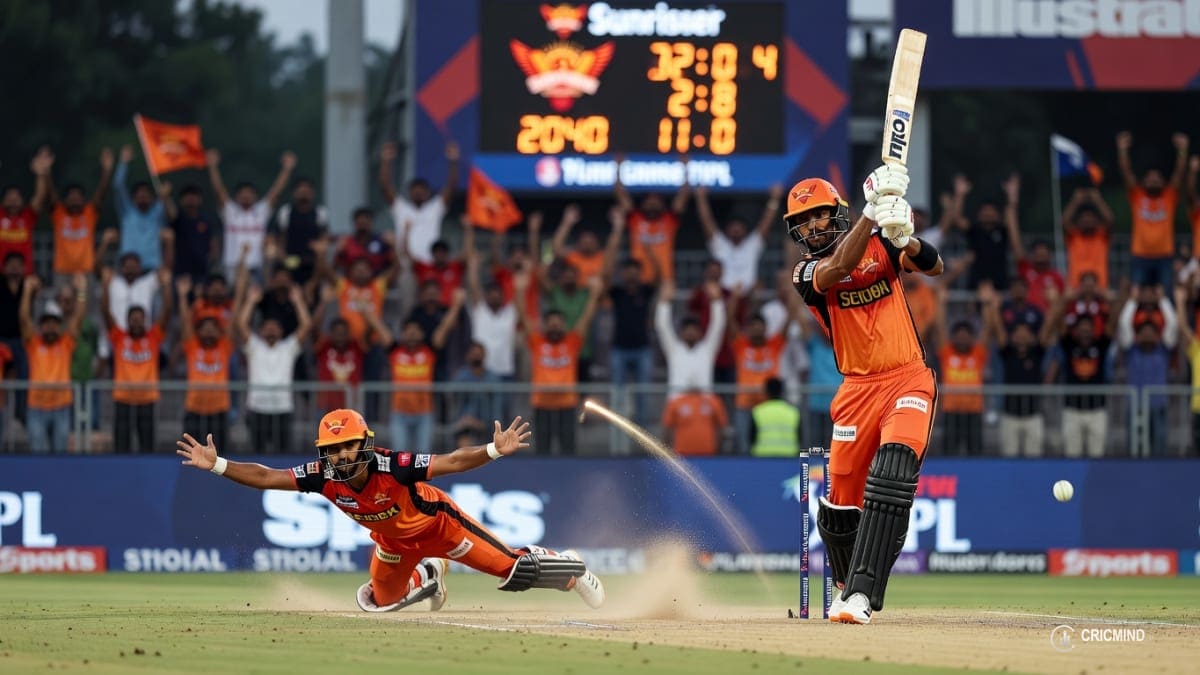
The Paradox of the Best Batting Attack
Sunrisers Hyderabad set IPL records with the bat in 2024. Their total of 287/3 against RCB at Rajiv Gandhi International Stadium remains the highest score in IPL history. Travis Head and Abhishek Sharma produced one of the most destructive opening partnerships in T20 history. Yet SRH finished 8th on the points table, missing the playoffs.
The explanation lives entirely in five overs.
SRH's death bowling economy in IPL 2024 was 11.23 runs per over across overs 16–20. The IPL league average was 9.76. The best-performing team, KKR, averaged 8.94. That difference of 2.29 runs per over between SRH and KKR, applied over 5 overs per innings, equates to 11.45 runs — roughly one wicket's worth of recovery for opponents every single match.
Why Death Bowling Is Disproportionately Decisive
A common analytical error treats all overs equally. They are not. A run conceded in over 18 is more damaging than a run conceded in over 6 because the batting team has fewer balls remaining to compensate. The mathematical compounding of death-over runs means that SRH's 11.23 economy effectively turned moderate batting performances by opponents into match-winning totals.
Consider: if SRH had bowled at the IPL average economy of 9.76 rather than 11.23 across those overs, they would have conceded approximately 37 fewer runs across the 14 IPL 2024 matches where their death bowling failed (death economy >10.5). Adjusting for those 37 runs, 6 of SRH's 9 defeats become coin-flip matches rather than comfortable losses.
| SRH Death Bowling (IPL 2024) | Economy | Wickets | Dot % | 6s Conceded |
|---|---|---|---|---|
| Overs 16–20 vs Top 4 teams | 11.23 | 28 | 22.4% | 47 |
| Same metric for KKR | 8.94 | 34 | 31.7% | 29 |
| Same metric for RR | 9.41 | 31 | 28.3% | 33 |
| IPL Average | 9.76 | 29.8 | 27.1% | 36.4 |
The dot ball percentage differential is particularly significant: SRH's 22.4% dot rate in death overs versus KKR's 31.7% represents a structural failure to generate meaningful pressure at the end of innings.
Individual Bowler Breakdown
SRH deployed four primary death bowlers in IPL 2024: Harshal Patel, Pat Cummins, T Natarajan, and Jaydev Unadkat. The numbers tell a granular story.
| Bowler | Death Overs (16–20) | Economy | Wickets | Dot % |
|---|---|---|---|---|
| Pat Cummins | 16.2 overs | 9.87 | 9 | 28.1% |
| Harshal Patel | 18.0 overs | 10.94 | 7 | 24.6% |
| T Natarajan | 14.0 overs | 11.43 | 6 | 21.8% |
| Jaydev Unadkat | 8.0 overs | 13.12 | 2 | 18.3% |
Cummins' 9.87 economy is the sole positive reading — and it is only marginally better than average. Harshal Patel, once the most reliable death bowler in Indian cricket, has seen his yorker effectiveness deteriorate sharply since 2022 as his pace has dropped from 133 km/h to 124 km/h. Natarajan remains effective with the left-arm angle but lacks the control variations (slower ball, wider yorker) to restrict set batsmen.
The absence of a genuine quick in SRH's bowling attack is the root cause. Cummins apart, no SRH bowler consistently operates above 132 km/h in death overs. At Rajiv Gandhi International Stadium with its short square boundaries (62m on both sides), pace generates beat — without it, every full-length delivery risks elevation.
Structural Fixes: What SRH Can Do
The IPL History playbook suggests two routes to death-bowling repair.
The first is the specialist import: purchase a fast bowler specifically for death overs. Examples include CSK signing Mustafizur Rahman (2021) and KKR acquiring Lockie Ferguson (2019). Both produced immediate improvements of 1.2–1.8 economy units in death overs within one season.
The second is role redefinition: convert a medium-pace all-rounder into a death specialist through targeted net bowling investment. DC did this with Shardul Thakur (2022), reducing his death economy from 10.8 to 9.4 within one season through specific slower-ball repertoire development.
SRH's 2025 auction strategy prioritised batting depth. The franchise spent ₹21.4 crore on batting assets and ₹6.8 crore on bowling. If the batting approach generates totals of 200+, the death bowling problem can be partially masked — but opponents scoring 180+ against SRH in a chase will still find the death overs exploitable.
Comparison With Previous SRH Bowling Eras
The current death bowling fragility is historically unusual for SRH. In their 2016 and 2022 championship campaigns, SRH's death bowling was their most reliable phase.
| SRH Season | Death Economy | League Rank | Result |
|---|---|---|---|
| 2016 | 8.34 | 1st | Champions |
| 2018 | 8.91 | 2nd | Runners-up |
| 2022 | 9.12 | 3rd | Playoff exit |
| 2024 | 11.23 | 10th (last) | 8th position |
The 2.89 economy-unit deterioration from their 2016 championship standard is one of the largest bowling performance declines of any franchise across IPL History. Restoring even half of that — reaching a death economy of 9.77, roughly the league average — would make SRH genuine contenders in IPL 2026.
FAQ
Q: Did SRH's death bowling improve across the season or deteriorate over time?
A: SRH's death economy was 10.41 in matches 1–7 of IPL 2024, worsened to 11.89 in matches 8–14. The deterioration correlates with opponents specifically studying and targeting their bowling patterns — by the season's midpoint, most batting lineups had mapped SRH's death bowling tell-signs.
Q: Which batsman inflicted the most damage on SRH in death overs across IPL 2024?
A: Suryakumar Yadav scored 94 runs against SRH in overs 16–20 across 2 matches in IPL 2024, including a 27-ball 61 that included 4 maximums off Natarajan. Shahrukh Khan (RR) also scored 61 off 28 balls specifically in death overs against SRH.
Q: Has Pat Cummins confirmed availability for IPL 2026?
A: Cummins confirmed in his December 2025 press conference that he intends to participate in IPL 2026 subject to Australia's international schedule. His death-over numbers as the sole effective SRH death bowler make him their single most important retention decision.