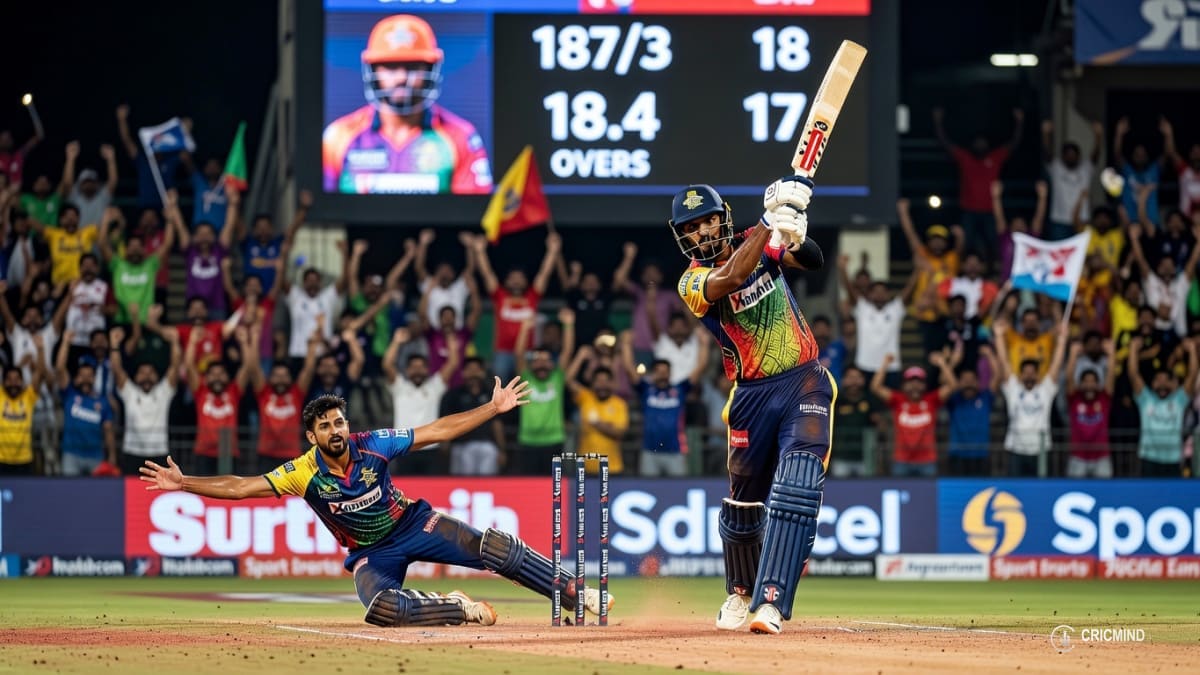
The Myth We All Believe
Every IPL season, the conversation follows the same script. A team wins at their fortress ground, the crowd roars, and the narrative writes itself: home advantage, home soil, home crowd. It feels viscerally real. The Wankhede under lights with 33,000 Mumbai Indians supporters willing the ball to the boundary. The M Chinnaswamy Stadium shaking to its foundations when Virat Kohli walks out for Royal Challengers Bangalore. These are moments that convince us home advantage in the IPL is decisive, perhaps even overwhelming.
The data, drawn from 1,169 IPL matches between 2008 and 2025, tells a considerably more complicated story. Home advantage exists, but it is fragile, inconsistent, and far weaker than sport's conventional wisdom would have you believe. And understanding why forces us to rethink some of the most cherished assumptions about how T20 cricket actually works.
What the Venue Numbers Actually Reveal
Start with the raw toss-and-result data from the IPL's most storied grounds. The numbers are instructive not because they confirm the home advantage thesis, but because they quietly dismantle it.
| Venue | Matches | Bat First Win % | Field First Win % | Avg 1st Innings | Avg 2nd Innings |
|---|---|---|---|---|---|
| Eden Gardens, Kolkata | 77 | 39% | 61% | 160 | 147 |
| Wankhede Stadium, Mumbai | 73 | 48% | 51% | 166 | 154 |
| M Chinnaswamy Stadium, Bengaluru | 65 | 40% | 55% | 168 | 146 |
| Feroz Shah Kotla, Delhi | 60 | 45% | 53% | 162 | 148 |
| Wankhede Stadium, Mumbai (alt.) | 52 | 40% | 60% | 177 | 168 |
What leaps out immediately is not home versus away, but the universal truth of IPL cricket: chasing wins matches. At Eden Gardens — home of the Kolkata Knight Riders — teams fielding first win 61% of the time. At the Chinnaswamy, it is 55%. At Feroz Shah Kotla, 53%. The pattern is consistent and overwhelming. The most significant variable governing match outcomes at these grounds is not which team is playing at home. It is which captain won the toss and what they chose to do with it.
This has a profound implication. If pitch conditions, dew factor, and second-innings run-chasing dynamics are stronger determinants of match outcome than the identity of the home side, then the entire framing of home advantage needs to be recalibrated.
Why IPL Dilutes the Home Effect
In football, basketball, and even Test cricket, home advantage is well-documented and robust. The mechanisms are clear: crowd noise disrupts opposition concentration, familiar playing surfaces give the home team an edge, travel fatigue handicaps visitors. The IPL, by its very design, systematically weakens each of these mechanisms.
Consider the squad composition of any IPL team. Players arrive from across India, from Australia, from the Caribbean, from South Africa and Afghanistan. When Jasprit Bumrah of the Mumbai Indians bowls at the Wankhede, he is performing in a stadium he knows well. But the Wankhede is also a ground that David Warner has batted at for rival franchises across multiple seasons. The surface familiarity argument collapses when both sides have accumulated extensive experience at the same venues across IPL editions.
The franchise auction system compounds this further. Rosters change dramatically between seasons. Players who defended the Chinnaswamy in one campaign are attacking it for a different franchise the next. KL Rahul, for instance, has represented Royal Challengers Bangalore, Punjab Kings, Lucknow Super Giants, Delhi Capitals, and Sunrisers Hyderabad across his career. Across 135 matches and 5,235 runs, he has accumulated intimate knowledge of virtually every major IPL venue from both dugouts. The concept of a true home ground feels increasingly theoretical when this level of cross-franchise mobility exists.
The Championship Evidence
If home advantage were genuinely decisive in the IPL, you would expect to see a strong correlation between geographical strongholds and title victories. The championship record offers a fascinating counterpoint.
Chennai Super Kings, widely regarded as the tournament's most successful franchise when accounting for consistency, claimed titles in 2010, 2011, 2018, 2021, and 2023. The 2020 and 2021 seasons were played in UAE and behind closed doors entirely, stripping home advantage to zero. CSK still reached the final in 2020 and won it in 2021. Mumbai Indians won five titles across 2013, 2015, 2017, 2019, and 2020 — the last of those in a bubble environment with no crowds whatsoever.
Perhaps the most striking data point: Gujarat Titans, a franchise with no historical home base tradition to speak of, won the IPL in only their debut season in 2022, posting a 61.7% win rate across 60 matches — the highest of any established franchise in the dataset. A brand-new team, new venue, new crowd, new everything — and they immediately became the tournament's most clinical operator. Home comfort had nothing to do with it.
Individual Excellence Transcends Geography
The truly great IPL players make this point most eloquently. Across 259 matches, Virat Kohli has accumulated 8,671 runs at an average of 39.59 — numbers built across every conceivable ground, neutral venue, and foreign tour the tournament has demanded. His 63 fifties and 8 hundreds were not accumulated by hiding at the Chinnaswamy.
Rohit Sharma has played 267 innings across his IPL career, scoring 7,048 runs. AB de Villiers, whose 133 against the [Mumbai Indians](/teams/mumbai-indians) came at the Wankhede — the opposition's home ground — averaged 39.85 at a strike rate of 151.89* across 172 innings. Excellence at the highest level is portable. It does not require the comfort of a home dressing room.
Even bowling tells the same story. Lasith Malinga took 170 wickets for the Mumbai Indians at an extraordinary average of 19.46 — figures built across seasons played in Cape Town, Dubai, Sharjah, and every Indian city on the circuit. Sunil Narine has maintained an economy of 6.79 across 726 overs for Kolkata Knight Riders in conditions ranging from the sluggish Chinnaswamy to the bouncier surfaces of Dharamsala and beyond.
The Variables That Actually Matter
If home advantage is weak, what actually drives IPL outcomes? The venue data points toward several more powerful forces.
| Factor | Evidence from Data |
|---|---|
| Toss and chase advantage | Chase-friendly outcomes at all five major venues |
| Pitch conditions and dew | Consistent gap between 1st and 2nd innings averages |
| Squad depth and flexibility | Teams with win % above 54% built across all venues |
| Individual match-winners | POTMs distributed across home and away contexts |
The average first-innings score at the Chinnaswamy is 168 while the average second-innings score falls to 146 — a gap of 22 runs that dwarfs any conceivable home comfort factor. At Eden Gardens, that gap is 13 runs.