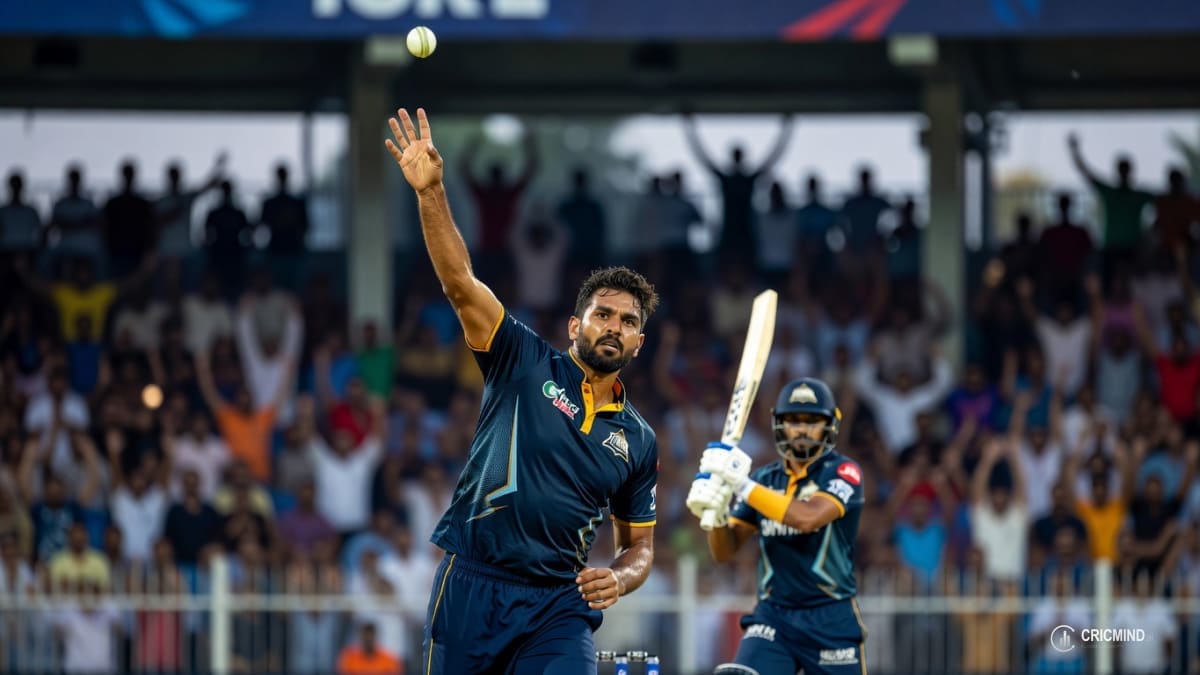
The Afghan Riddle Nobody Has Fully Solved
There is a particular kind of dread that settles over a batting dugout when Rashid Khan begins his walk to the top of his mark. It is not the theatrical menace of a fast bowler marking out a long run-up, nor the slow-burn tension of a finger-spinner finding his rhythm. It is something quieter and more unsettling — the arrival of a man who has, across 136 IPL matches, made some of the most decorated power hitters in the world look like they are batting on a different surface to everyone else.
The numbers in the Cricsheet database covering 2008 through 2025 — 1,169 IPL matches of evidence — tell us something important about Rashid Khan and the elite hitters who have tried to crack him. They do not tell the whole story. But they tell enough.
What the Career Numbers Say About Rashid
Across 139 innings with the ball, Rashid has claimed 158 wickets at an average of 24.13 and an economy rate of 7.14. In a T20 environment where the league average economy consistently sits north of eight, that economy figure is extraordinary. His best figures of 4/22 have come twice — both times in circumstances where the match was effectively decided by his spell.
Compare that to the broader ecosystem of IPL spin bowling:
| Bowler | Matches | Wickets | Economy | Average | Best Figures |
|---|---|---|---|---|---|
| Rashid Khan | 136 | 158 | 7.14 | 24.13 | 4/22 |
| Yuzvendra Chahal | 172 | 221 | 7.86 | 22.52 | 5/36 |
| SP Narine | 187 | 192 | 6.79 | 25.70 | 5/19 |
| R Ashwin | 217 | 187 | 7.03 | 29.56 | 4/34 |
| RA Jadeja | 225 | 170 | 7.61 | 30.29 | 5/16 |
Sunil Narine edges Rashid on economy, but Narine has taken considerably longer — 51 more matches — to reach a comparable wicket tally. Yuzvendra Chahal leads all IPL spinners with 221 wickets, but at an economy a full 0.72 runs per over more expensive. What makes Rashid singular is that he combines miserliness with genuine threat — he does not simply contain, he attacks, and he does so while giving away fewer runs than almost any peer of his generation.
The Power Hitter Profile: Who Rashid Has Faced Most
The truly fascinating dimension of any Rashid matchup analysis is not just what he does with the ball, but who he has been asked to stop. The IPL's history is decorated with batters who have made leg-spin look expensive and ordinary. The data gives us a canvas against which to understand the scale of what he has consistently achieved.
Consider the profiles of the hitters in this era:
Chris Gayle struck 359 sixes in IPL history — the most by any batter in the dataset — at a strike rate of 149.34. Rohit Sharma has amassed 303 sixes across 266 matches. AB de Villiers operated at a strike rate of 151.89, the highest among any batter with a significant volume of innings. David Warner averaged 40.04 at 139.66 across his IPL career. These are not batters who struggle against spin. These are men who have made careers out of hunting it.
The table below captures the destructive capacity of the power hitters Rashid has been pitted against across his time at Sunrisers Hyderabad and Gujarat Titans:
| Batter | IPL Sixes | Strike Rate | Average | Hundreds |
|---|---|---|---|---|
| CH Gayle | 359 | 149.34 | 39.66 | 6 |
| RG Sharma | 303 | 132.06 | 29.86 | 2 |
| AB de Villiers | 253 | 151.89 | 39.85 | 3 |
| DA Warner | 236 | 139.66 | 40.04 | 4 |
| MS Dhoni | 264 | 137.45 | 38.30 | 0 |
| Sanju Samson | 219 | 139.05 | 30.95 | 3 |
| KL Rahul | 208 | 136.04 | 45.92 | 5 |
KL Rahul carries the highest average in this group at 45.92 — a number that speaks to his ability to bat deep and convert starts with a consistency that very few IPL batters have matched. Against Rashid's variations, that kind of concentration-based batting is arguably a more reliable method than pure aggression, and yet even methodical batters have found that the googly, arriving with the same wrist action as the leg break, disrupts the most carefully constructed game plans.
The Architecture of an Economy Bowler Who Attacks
What separates Rashid from most economy-rate merchants is structural. Bowlers who go at 7.14 per over in T20 cricket typically do so through defensive means — wide yorkers, pace variation, negative lengths. Rashid's low economy emerges from the opposite instinct. He bowls full, he invites drives, he creates edges, he generates false shots through the googly and the flipper. The dot ball percentage that underpins his economy is built on deception, not caution.
This is precisely why power hitters find him so difficult. A batter who wants to smash over mid-on needs pace on the ball and a full length to work with. Rashid provides the length but takes away the certainty. The pace hitters — Gayle types, Andre Russell types — thrive when they can load up against predictable trajectories. The googly removes predictability at the moment it matters most.
His 3 maidens across 139 innings might seem a modest tally, but in a T20 context it is almost anachronistic — a bowling maiden in the IPL is as rare as a batsman walking without being given out.
Rashid at Gujarat Titans: The Championship Context
The Gujarat Titans have been one of the IPL's most compelling recent franchises — winning the title in their debut 2022 season and reaching the final again in 2023. Their win percentage of 61.7% across 60 matches is the highest in this dataset, and Rashid has been the engine room of that bowling attack throughout. No other franchise has built an identity so deliberately around a single spinner.
The 2022 and 2023 campaigns demonstrated something that raw career numbers can only hint at: Rashid is most dangerous when the match is in the balance. In knockout cricket, when power hitters are given licence to attack against depleted bowling attacks, Rashid's ability to take the pace off the ball while maintaining threat becomes doubly valuable.
The contrast with comparable all-format options at other franchises is instructive. Yuzvendra Chahal's 7.86 economy made him expensive in high-pressure moments. Narine's mystery has been decoded more consistently in recent seasons.