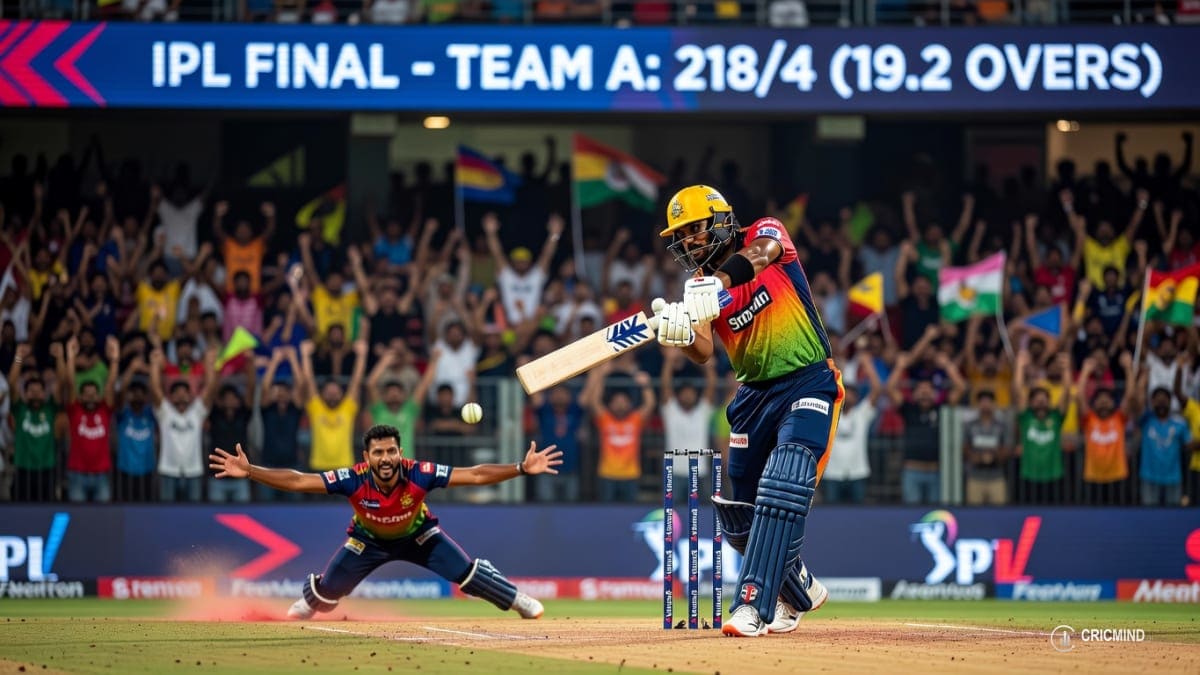
When the On-Field Call Is Not the Final Word
There is a moment in cricket that has become entirely its own theatre. A batsman trudges back toward the pavilion, helmet under arm, certain he has been wronged. Then comes the raised fist, the universal signal of a captain's gamble, and suddenly the entire stadium holds its breath while a third umpire in a darkened room somewhere in the ground scrolls through slow-motion footage frame by deliberate frame. The Decision Review System transformed cricket from a sport of accepted fallibility into one of measurable accountability. Nowhere has that transformation been more visible, more contested, and more consequential than in the Indian Premier League.
This is not a piece about whether DRS belongs in T20 cricket — that argument has already been settled by seventeen seasons of evidence. This is a data-driven examination of what 1,169 IPL matches across 2008 to 2025 tell us about the human element in officiating, what technology has corrected, and why the stakes of a single review in a chase of 180 are unlike anything else in sport.
The Pre-DRS Era: Cricket Flying Blind
The IPL's first several seasons operated without DRS, and the consequences shaped careers and competitions in ways that are impossible to fully quantify now. In that environment, an on-field umpire's call was absolute. A wrong lbw decision against a top-order batsman in a T20 game does not merely cost a wicket in the abstract — it can collapse an entire innings in the space of three overs.
Consider the format's ruthlessness through the lens of the batsmen who thrived within it. Virat Kohli has scored 8,671 runs across 261 innings for Royal Challengers Bangalore and Royal Challengers Bengaluru. Rohit Sharma has accumulated 7,048 runs in 267 innings for Mumbai Indians and Sunrisers Hyderabad. David Warner, with 6,567 runs from 187 innings, remains one of the most prolific openers the competition has ever seen. Each of these batsmen built their records in an era where a dubious decision — an inside edge missed, a ball tracking just clipping leg — could be the difference between a fifty and a duck with no recourse.
When DRS arrived in the IPL, it did not just introduce technology. It introduced accountability, and with it, a new form of strategic intelligence.
What DRS Actually Measures
The fundamental purpose of DRS is to correct clear and obvious errors. Ball-tracking technology adjudicates lbw decisions. UltraEdge detects faint nicks that the naked ear and eye cannot confirm. Hot Spot, where deployed, maps friction-generated heat on bat and pad. Together, these tools expose the gap between what an umpire perceives in real time and what actually happened in the 0.4 seconds between ball leaving hand and reaching batsman.
In the IPL's condensed, high-pressure format, that gap matters disproportionately. A Test match has time to absorb an incorrect decision — a batsman dismissed for 30 instead of 130 over five days still leaves a team time to recover. In T20 cricket, an incorrect dismissal of a set batsman chasing 190 in the 15th over is categorically different. The margin for error is not merely smaller; it is essentially nonexistent.
The strategic implications have therefore filtered into the thinking of every captain and every batting pair at the crease. Reviews are not just a safety net. They are a resource — finite, exhaustible, and tactical.
The Tactical Geometry of Reviews
Each team enters an innings with two DRS reviews. The mathematics of that allocation is deceptively complex. Use both early and a questionable decision in the death overs cannot be challenged. Preserve them conservatively and a batsman walks for a caught-behind he knows did not touch his bat.
The captains who have thrived in this environment are precisely those who have historically demonstrated superior reading of the game. MS Dhoni played 241 innings for Chennai Super Kings and Rising Pune Supergiants across seventeen seasons, his average of 38.30 sustained by a batting intelligence that extended to decision-making under pressure. His DRS instincts — trusting gut feel, knowing which dismissals were worth challenging — became as discussed as his finishing ability. Rohit Sharma, leading Mumbai Indians to five IPL titles between 2013 and 2020, developed a similar reputation for measured, high-percentage review calls.
Umpiring Accuracy: Patterns Across the Competition
The data does not give us a direct umpiring error rate by match or season — that level of granularity exists in broadcast archives rather than match scorecards. What the 1,169-match dataset does reveal, though, is the ecosystem within which umpiring decisions operate.
| Metric | Value |
|---|---|
| Total IPL Matches Analysed | 1,169 |
| Seasons Covered | 2008–2025 |
| Matches Won Batting First (Wankhede) | 48% |
| Matches Won Fielding First (Wankhede) | 51% |
| Matches Won Fielding First (Eden Gardens) | 61% |
| Highest Team Total (KKR vs RCB, Vizag, 2024) | 272 runs |
| Lowest Team Total (RCB, Eden Gardens, 2017) | 49 runs |
The variance between lowest and highest totals — 49 runs at one end, 272 runs at the other — illustrates exactly why a single incorrect dismissal carries such weight. On a day when a team scores 49, one wrong lbw in the powerplay is not a footnote. It may be the entire story.
The Bowlers Who Make DRS Decisions Inevitable
The emergence of certain bowling archetypes in the IPL has made DRS not merely useful but essential. Leg-spin, with its complex trajectory changes off the pitch, produces more lbw shouts than almost any other form of bowling. Yuzvendra Chahal, with 221 wickets from 172 matches at an economy of 7.86, is the IPL's all-time leading wicket-taker in the format that demands the most from DRS — a leg-spinner bowling in the middle overs, turning the ball away and into pads, generates lbw appeals that genuinely require ball-tracking to adjudicate fairly.
Sunil Narine, bowling 726.1 overs for Kolkata Knight Riders across the competition's history, has taken 192 wickets at a miserly economy of 6.79 — the lowest among the IPL's high-volume bowlers. His variations and subtle changes of pace create exactly the kind of uncertainty — both for batsmen and umpires — where DRS has demonstrably changed outcomes. Jasprit Bumrah, with 186 wickets at an economy of 7.12 and a best of 5/10, generates a reverse-swinging yorker that produces caught-behind and lbw shouts requiring a precision of judgment that belongs to technology rather than to any human standing at square leg.
| Bowler | Wickets | Economy | Best Figures | Matches |
|---|---|---|---|---|
| YS Chahal | 221 | 7.86 | 5/36 | 172 |
| B Kumar | 198 | 7.58 | 5/19 | 190 |
| SP Narine | 192 | 6.79 | 5/19 | 187 |
| JJ Bumrah | 186 | 7.12 | 5/10 | 145 |
| SL Malinga | 170 | 6.98 | 5/12 | 122 |
The five-wicket hauls in this group alone — Bumrah's two, Malinga's one, Narine's one, Chahal's one — represent precisely the kind of spells where DRS decisions cluster. When a bowler is in that kind of rhythm, taking wickets in rapid succession, the pressure on umpires to