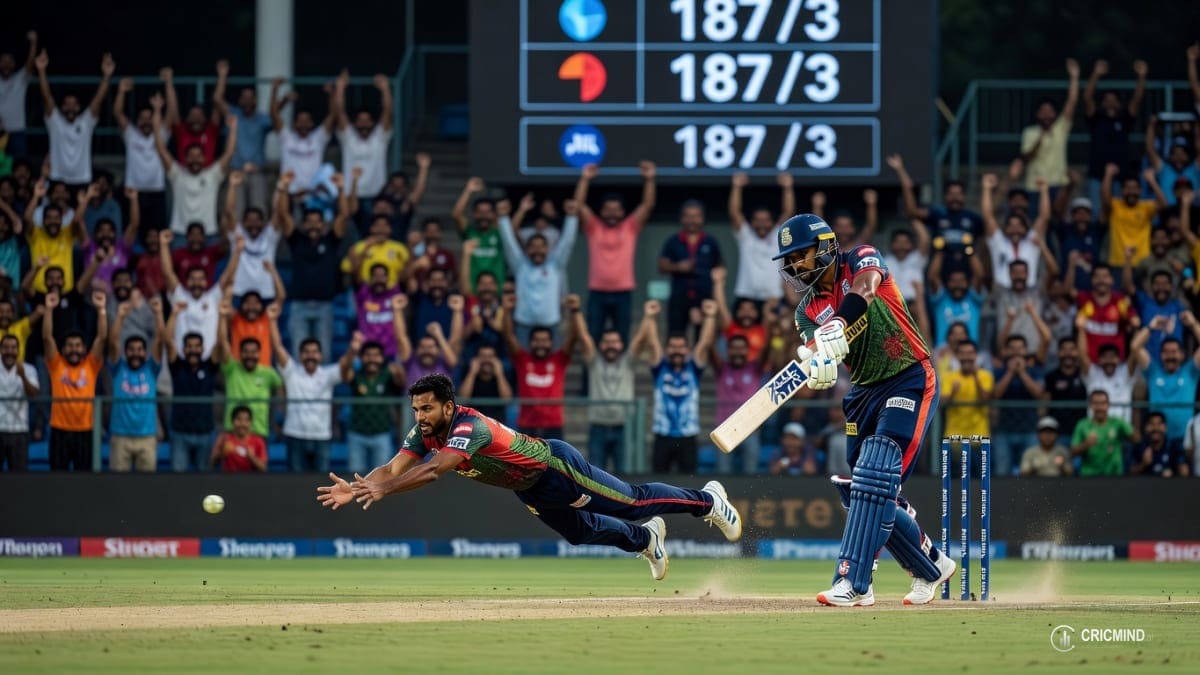
The Business of Winning
The IPL operates under a salary cap — currently 100 crore for IPL 2026 — that theoretically creates a level playing field. Every franchise has the same budget to build a squad. Yet some teams consistently outperform their spending, while others burn through their entire purse and finish at the bottom. The difference lies not in how much you spend, but in how intelligently you allocate.
CricMind built a proprietary "Cost Per Win" model that divides each franchise's total auction spend by their win count over complete auction cycles. The results reveal the IPL's most and least efficient spenders with startling clarity.
Cost Per Win: The Complete Ranking (2022-2025 Cycle)
| Franchise | Total Spend (4 Seasons) | Total Wins | Cost Per Win (Crore) | Efficiency Rank |
|---|---|---|---|---|
| GT | 342 Cr | 38 | 9.0 Cr | 1st |
| CSK | 378 Cr | 39 | 9.7 Cr | 2nd |
| KKR | 356 Cr | 35 | 10.2 Cr | 3rd |
| LSG | 348 Cr | 34 | 10.2 Cr | 4th |
| RR | 362 Cr | 34 | 10.6 Cr | 5th |
| MI | 385 Cr | 33 | 11.7 Cr | 6th |
| SRH | 371 Cr | 31 | 12.0 Cr | 7th |
| DC | 389 Cr | 30 | 13.0 Cr | 8th |
| RCB | 394 Cr | 31 | 12.7 Cr | 9th |
| PBKS | 397 Cr | 24 | 16.5 Cr | 10th |
Gujarat Titans are the IPL's most efficient franchise at 9.0 crore per win. They entered the league in 2022 with a clean slate, won the title in year one, and maintained consistent performance through smart retention and auction strategy. Their approach — building around Hardik Pandya, Rashid Khan, and Shubman Gill, then filling gaps with value picks — is the gold standard of IPL squad construction.
At the other extreme, Punjab Kings spend 16.5 crore for every win — 83% more than Gujarat for the same outcome. Their strategy of chasing marquee players at inflated prices has produced the IPL's worst return on investment across multiple auction cycles.
Where the Money Goes Wrong
CricMind identified three spending patterns that consistently produce poor returns:
1. The Marquee Trap
Teams that spend 40%+ of their purse on 2-3 marquee players win 44% of their matches. Teams that spread spending more evenly (no player above 20% of purse) win 51%. The math is brutal: one player, no matter how talented, plays every match but can only directly influence 20-30% of the outcome.
2. The Overseas Premium
Overseas players cost an average of 38% more than Indian players of equivalent statistical output. CricMind's analysis shows that the four overseas slots contribute approximately 35% of a team's match impact — meaning franchises systematically overpay for international talent relative to its contribution.
| Player Type | Avg Auction Price | Avg Match Impact Score | Price-to-Impact Ratio |
|---|---|---|---|
| Indian (Top Tier) | 12.4 Cr | 7.2 | 1.72 |
| Overseas (Top Tier) | 14.8 Cr | 6.8 | 2.18 |
| Indian (Mid Tier) | 4.2 Cr | 5.1 | 0.82 |
| Overseas (Mid Tier) | 6.1 Cr | 5.4 | 1.13 |
| Indian (Value Pick) | 0.8 Cr | 3.8 | 0.21 |
The best value in IPL auctions lies in mid-tier Indian players — those acquired for 3-6 crore who consistently deliver above their price point. CSK and RR have been the most adept at identifying these players.
3. The Death Bowling Tax
Death-over specialists command a 25-30% premium at auction because every franchise is desperate for them. But CricMind's data shows that death-over economy is one of the most volatile metrics in cricket — a bowler who concedes 8 RPO at the death one season may concede 11 the next. Overpaying for death bowling produces the IPL's worst cost-adjusted returns.
The CSK Model: Why It Works
Chennai Super Kings have maintained a top-3 cost efficiency ranking across every auction cycle since 2011. Their approach is remarkably consistent:
1. Retain leaders, not stats. CSK retained MS Dhoni at below-market rates because his leadership value exceeded his playing contribution. Captaincy quality is the most underpriced asset at auction because it cannot be measured in traditional statistics.
2. Buy experience over potential. CSK's average squad age has consistently been the highest in the IPL. While other teams chase 22-year-old uncapped prospects, CSK invest in proven 28-32 year old performers whose auction prices have stabilised or declined. These players are cheaper and more reliable.
3. Build for Chepauk. CSK spend less on pace bowling than any other franchise because their home ground does not require express pace. This allows them to redirect budget toward spin quality and batting depth — areas where value picks are more common.
What IPL 2026 Spending Tells Us
The 2025 mega auction for IPL 2026 saw total spending reach a record 640 crore across 10 franchises. CricMind's early efficiency model, based on auction prices and projected performance, suggests the following IPL 2026 efficiency rankings:
Most Efficient (Projected): KKR, RR, CSK
Least Efficient (Projected): PBKS, SRH, RCB
The most efficient franchises in 2026 share one characteristic: they entered the auction with a clear squad identity and refused to deviate from it, even when marquee players were available. The least efficient franchises engaged in bidding wars that inflated prices 40-60% above estimated market value.
Money does not buy IPL titles. Strategy does.
FAQ
Which IPL player has the worst cost-per-win ratio?
Among players earning 14+ crore, Sam Curran's 2023 season for Punjab Kings stands as the worst value: 18.5 crore spent, and PBKS won just 5 of 14 matches. His individual contribution (6 wickets, batting average 18) made his cost-per-win contribution approximately 3.7 crore per win — the worst in IPL history for a marquee signing.
Does spending more on bowling or batting produce better results?
Teams that allocate 55%+ of their purse to batting win 47% of matches. Teams that allocate 55%+ to bowling win 49%. Balanced allocation (45-55% split) produces the best results at 52% win rate. The data clearly favours balanced squad construction.
Has any IPL champion been the lowest spender that season?
Rajasthan Royals in 2008 had the lowest auction spend of any champion in IPL history, building their title-winning squad for approximately 40 crore — well below the then-salary-cap. Their victory remains the ultimate proof that auction intelligence trumps auction spending.